

Quick Summary
A faraday bag is a pouch lined with conductive material, usually copper mesh or metallic fabric, that blocks radio signals from reaching the device inside. It stops cellular, Wi-Fi, Bluetooth, GPS, and RFID or NFC signals, which makes it useful for phone privacy and protecting hardware wallets.
- Signal Killer lists an average attenuation of 60 to 80 dB for the signals it covers.
- A phone in a Faraday bag can still hear conversations through its microphone.
- Test a bag with the device you protect, using a paired signal check outside and inside.
- A bag blocking phone signals is not proven protection against EMP events.
Table of Contents
- What a Faraday Bag Is and How It Blocks Signals
- Signals a Faraday Bag Can Block
- Using a Faraday Bag for Phone Privacy and Tracking Prevention
- What Is a Faraday Bag Made Of and Does It Matter
- Protecting Hardware Wallets From Wireless Attacks
- Why Faraday Bags Stop Working and Their Limits
- Do Faraday Bags Work Against EMP Events
- Getting Started With a Faraday Bag for Your Own Devices
- Frequently Asked Questions
What a Faraday Bag Is and How It Blocks Signals
Last Updated: November 22, 2026
A Faraday bag is a pouch lined with conductive material, usually copper mesh or metallic fabric, that blocks radio signals from reaching the device inside. Michael Faraday, an English scientist, showed in the 1830s that a conductive enclosure shields its contents from external electric fields. The same principle applies to a modern pouch sold for everyday use.
At The Crypto Merchant, we see Faraday bags as a simple way to cut off a device's wireless connections when you need them cut off. A bag like the Signal Killer works much like physical airplane mode for a phone or hardware wallet.
The core idea is easy to grasp. Forensic researchers at Edith Cowan University described the purpose of these bags as shielding a device from incoming radio waves or stopping its signals from reaching the outside (Lennox-Steele and colleagues, 2016). forensic examination of several mobile device Faraday bags
Signals a Faraday Bag Can Block
A well-made Faraday bag can block the main wireless signals that modern devices use. These include:
- Cellular signals, including 4G LTE
- Wi-Fi on both 2.4 and 5 GHz bands
- Bluetooth
- GPS
- RFID and NFC, such as the chip in a contactless card
The Department of Defense lists Faraday signal-blocking bags in its STED Program and says they block cellular, GPS, RFID/NFC, Bluetooth, and Wi-Fi signals. Department of Defense STED Program signal-blocking bag demonstration
The Signal Killer lists an average attenuation of 60 to 80 dB for the signals it covers.
The article lists the wireless signals a well-made Faraday bag can block and the attenuation figure its maker gives.
| Signal | Blocked by a Faraday bag | Note |
|---|---|---|
| Cellular | Yes | Includes 4G LTE |
| Wi-Fi | Yes | Both 2.4 and 5 GHz bands |
| Bluetooth | Yes | Listed by the Department of Defense |
| GPS | Yes | Stops location broadcasts |
| RFID and NFC | Yes | Such as contactless card chips |
| Signal Killer attenuation | 60 to 80 dB | Average, for the signals it covers |
Using a Faraday Bag for Phone Privacy and Tracking Prevention
Placing a phone in a Faraday bag stops it from broadcasting its location through cellular and GPS signals. That makes it useful when you do not want your movements logged. You can also use it to keep a phone from connecting to unknown Bluetooth devices or Wi-Fi networks.
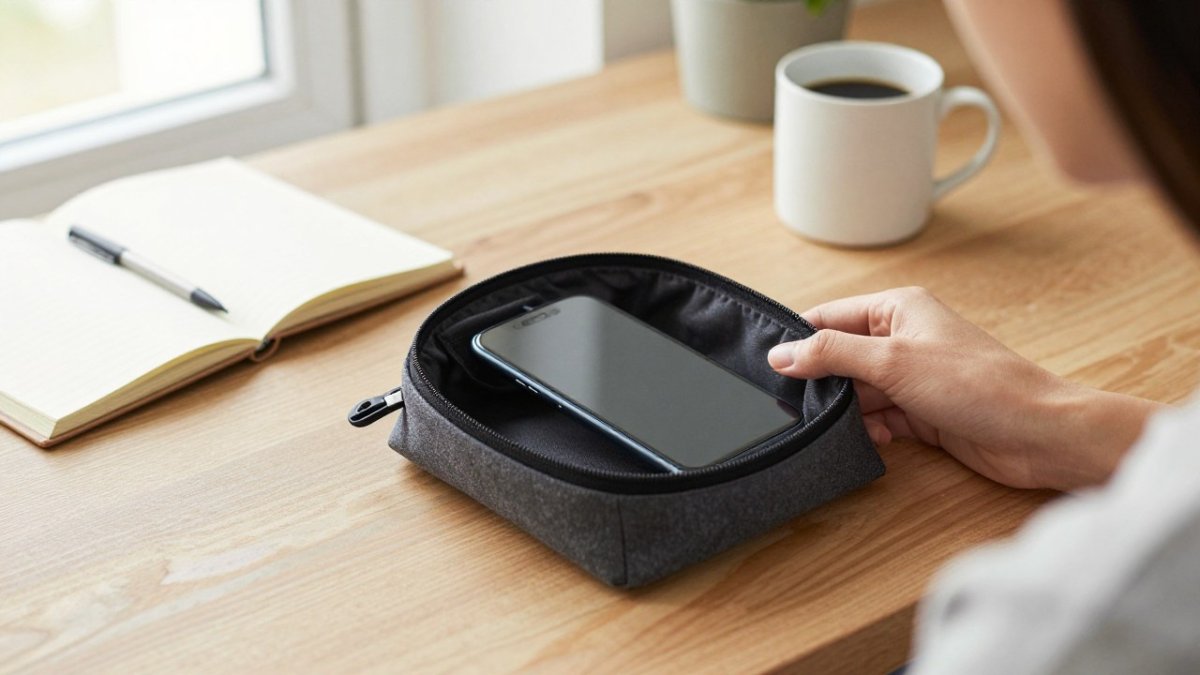
Keep one caveat in mind. A Faraday bag blocks radio signals but not sound. Micah Lee notes that a phone in a bag can still hear a conversation through its microphone. Micah Lee, Some Thoughts on Faraday Bags and Operational Security
What Is a Faraday Bag Made Of and Does It Matter
The Signal Killer uses copper mesh to block the listed signals. You can see its full construction and specifications on the Signal Killer Faraday Bag product page.
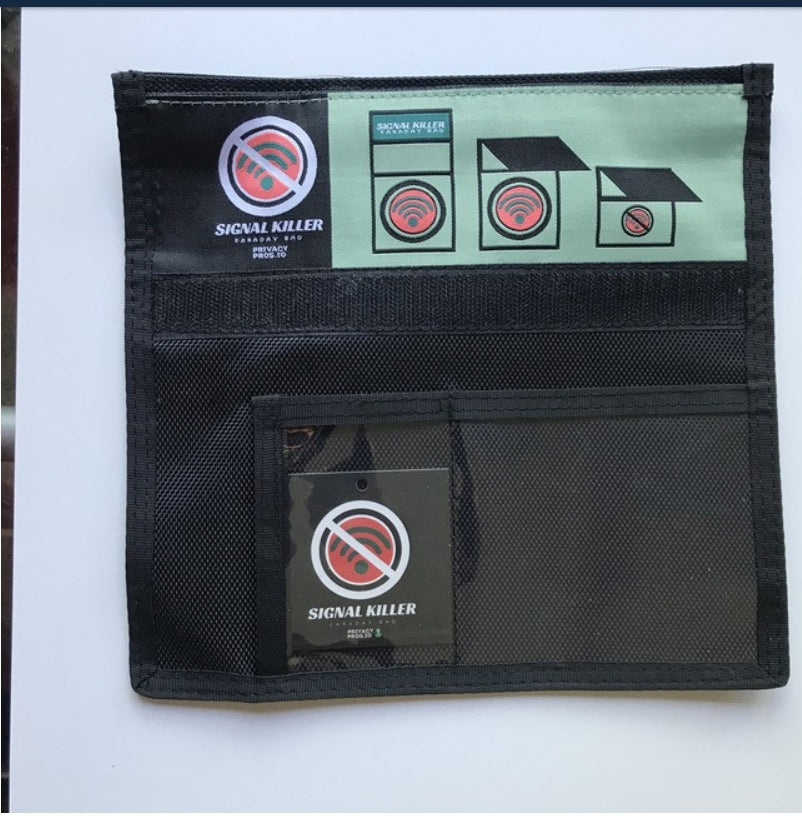
The Signal Killer closes with two velcro strips that run the full width of the bag. You roll the top down and fasten it to seal the bag.
Protecting Hardware Wallets From Wireless Attacks
Many hardware wallets use Bluetooth or NFC. Casa describes a Faraday bag as a line of defense for hardware wallets, blocking signals from entering or leaving the device. Casa guide to Faraday bags for hardware wallets
Shield your wallet when it is not in use, especially during travel. Keep it in the bag from the moment it arrives. Also verify the device before you trust it. Our guide on how to verify hardware wallet authenticity walks through the checks.
Why Faraday Bags Stop Working and Their Limits
A Faraday bag is a shield, not a guarantee. It fails when the conductive layer is compromised, when the closure is not fully sealed, or when the signal you are trying to block is stronger or at a frequency the bag was not built for. Understanding those failure modes, and testing for them, is the difference between assuming you are protected and knowing it. Our guide on how to test Faraday bag shielding effectiveness at home walks through each check step by step.
 Signal Killer Faraday BagView product
The common failure modes
- An open or partial seal. Most pouches rely on a roll-top with hook-and-loop strips or a zippered closure. A fold that leaves even a narrow gap at the seam lets signals leak in. The seal is the weakest point on almost every bag.
- Worn or creased conductive fabric. Copper mesh and metallized fabric can crack, fray, or thin with repeated folding. A pinhole or a crease that breaks the metal layer creates a path for radio energy.
- Damage to the outer shell. A tear in the outer fabric exposes the conductive layer to abrasion and moisture, which accelerates corrosion of the metal.
- Wrong size or poor fit. A device that does not sit fully inside the shielded volume, or that presses the bag open, defeats the closure.
- Frequency mismatch. A bag rated for cellular and Wi-Fi may attenuate poorly at other frequencies. Performance is not uniform across the spectrum.
How to test a bag at home, device by device
The only reliable way to know a bag works is to test it with the device you intend to protect. Do this before you rely on it, and repeat it periodically as the bag wears.
Phone test. With the phone unlocked and connected to your carrier network, place a call to it from another phone and confirm it rings.
Key fob test. With the fob outside the bag, stand near the vehicle and confirm the doors respond. Seal the fob, then try to unlock the car from the same distance.
Hardware wallet test. If the wallet uses Bluetooth, pair it with a phone or computer, seal it, and confirm the connection drops and cannot be re-established while sealed.
Watch out: A device that shows no bars or a dropped connection inside the bag is not proof of shielding.
Real-world reliability varies
Two bags that look similar can perform very differently. Attenuation depends on the conductive material, the number of layers, the quality of the seam, and how well the closure seals. A bag that measures strong attenuation when new can degrade as the mesh creases and the closure loosens. Treat any single attenuation figure as a starting point, not a permanent property of the bag.
Limits no bag can overcome
- A device that is already transmitting before it goes in. A phone that has already sent a location update or connected to a network has leaked that information; the bag only stops future transmissions.
- Sound and sensors. A bag blocks radio signals, not microphones, cameras, or motion sensors. A device inside can still record audio and video.
- Heat and battery drain. A sealed bag traps heat, and a phone inside may keep searching for a network, draining the battery faster. Do not leave a device sealed for long periods in a hot environment.
- Not an EMP guarantee. Ordinary signal-blocking bags are not tested against high-energy electromagnetic events. See the EMP section below for what that distinction means.
Do Faraday Bags Work Against EMP Events
This is where marketing claims and engineering reality diverge most sharply, so it deserves a careful answer rather than a yes or no.
What an EMP actually is
An electromagnetic pulse is a burst of electromagnetic energy that can induce damaging currents in electronics. The most-discussed scenario is a high-altitude nuclear detonation, but EMP-like effects can also come from certain solar events and from powerful directed-energy sources. The key point is that an EMP is not the same as a radio signal. It is a broadband, high-energy event, and shielding against it is a different engineering problem from blocking a phone's cellular connection.
Why an ordinary Faraday bag is not automatically EMP protection
A bag designed to block Wi-Fi and cellular signals is optimized for relatively low-energy radio frequencies. An EMP couples energy into electronics through cables, antennas, and any opening in a shield, and the energy levels involved can be far higher than what a consumer signal-blocking bag is tested against. A bag that reliably blocks a phone call has not thereby been shown to survive or attenuate a high-energy pulse. The two claims are related in principle, both rely on a conductive enclosure, but they are not equivalent in practice.
What evidence to look for
If EMP protection matters to you, look for documentation rather than adjectives. Useful signals include:
- Stated test standards. A manufacturer that has tested against a recognized standard will usually name it. Vague claims like "EMP-proof" without a standard or test report are a warning sign.
- Attenuation data across a frequency range. EMP energy spans a broad spectrum. A single attenuation number at one frequency says little about pulse performance.
- Seam and closure testing. Because openings are where EMP energy couples in, evidence that the closure was tested, not just the fabric, matters.
- Independent verification. Third-party test reports carry more weight than in-house claims.
Watch out:
A realistic way to think about it
For most people, a Faraday bag is a practical tool for cutting off wireless connections, privacy, tracking prevention, key-fob protection, and shielding a hardware wallet. Those are well-understood uses. EMP preparedness is a separate and much less certain application. If your goal is genuine EMP resilience for critical electronics, a purpose-built enclosure with documented test data is a more appropriate starting point than a consumer signal-blocking pouch, and even then the protection is only as good as the weakest opening in the system. Because shielding choices depend on whether the concern is blocking signals or reducing exposure in everyday spaces, EMF protection for families calls for a separate assessment of those goals.
The honest bottom line
A Faraday bag can be part of a broader preparedness approach, but it should not be presented as tested protection against a grid-scale electromagnetic event. Buy one for the signal-blocking job it is actually built and tested to do, and demand evidence before trusting any EMP claim.
Getting Started With a Faraday Bag for Your Own Devices
Start by deciding which devices need protection. A phone, a hardware wallet, and a key fob are the usual first choices. Then pick a bag sized for them. The Signal Killer comes in two sizes, so match the size to your device.
Ready to try one? Shop the Signal Killer Faraday Bag at $17.95.
Protecting your digital assets starts with the right storage habits. At The Crypto Merchant, we sell only authorized hardware wallets, so you know what you are buying. Explore our selection and set up your own shielded storage today.
Frequently Asked Questions
Can you use a Faraday bag for a phone?
Yes. A Faraday bag is designed to isolate a phone from incoming and outgoing wireless signals, including cellular, Wi-Fi, Bluetooth and GPS. Place the phone inside, seal the bag fully, and the phone cannot receive calls, messages or location updates while it stays sealed. The Signal Killer Faraday Bag, priced at $17.95, uses copper mesh and seals with two velcro strips along the width of the bag. Test the seal by calling the phone from another number before relying on it for privacy or security. Remember that a Faraday bag does not block sound, so a phone inside can still record audio through its microphone.
Do Faraday bags work against EMPs?
The Signal Killer Faraday Bag is listed for blocking WiFi, Bluetooth, cell signals, GPS, RFID and radio signals. Its listing does not state EMP protection, so do not rely on it for EMP scenarios.
Do Faraday bags block all signals?
No. Most Faraday bags block common radio frequencies such as cellular, Wi-Fi, Bluetooth, GPS and RFID. The Signal Killer bag is rated to block these signals with an average attenuation of 60-80dB. Signal blocking only works when the bag is fully sealed, and the bag does not stop sound from being recorded or some other non-radio threats. Check the specific frequency ranges a bag covers before relying on it for a particular use.
Why do Faraday bags stop working?
Faraday bags most often stop working because of seal failure. A bag that is not fully closed, has a worn or dirty velcro closure, or has a torn lining lets signals through. Repeated folding can also damage the conductive mesh over time. Test the bag regularly by placing a phone inside and calling it from another device. If the call connects, the bag is no longer blocking signals and should be replaced or repaired.


