

Table of Contents
- SecuX vs Ledger Wallet: Quick Comparison
- Security and Private-Key Protection: SecuX vs Ledger
- Supported Cryptocurrencies: SecuX vs Ledger Coin Support
- SecuX W20 vs Ledger Nano X: Feature-by-Feature Breakdown
- Hardware Wallet Recovery Phrase and Backup Strategy
- Price and Value Comparison
- Which Wallet Should You Choose?
- Conclusion
- Frequently Asked Questions
Last Updated: October 20, 2026
SecuX vs Ledger Wallet: Quick Comparison
When comparing secux vs ledger wallet, both keep your private keys offline, away from hackers and exchanges, but they differ in design, supported assets, connectivity, and price. Understanding those differences helps you pick the right wallet.
The Crypto Merchant carries both brands as an authorized distributor, so every wallet we sell is verified secure and authentic. This comparison breaks down where each brand excels and where it falls short.
Comparison Table
| Feature | SecuX W20 | SecuX V20 | Ledger Nano X | Ledger Nano S Plus |
|---|---|---|---|---|
| Price | $109.99 | $119.99 | $99.00 | $59.00 |
| Display | 2.8" color touchscreen | 2.8" color touchscreen | Small OLED | 1.1" monochrome OLED |
| Connectivity | Bluetooth + USB | Bluetooth + USB | Bluetooth + USB-C | USB-C only |
| Mobile Support | Android | iOS + Android | iOS + Android | Android only |
| Supported Assets | 1,000+ coins | 1,000+ coins | 100 apps installable | 15,000+ coins |
| Battery | 7 hours | Rechargeable | None (USB powered) | None (USB powered) |
| Best For | Budget-conscious users | Premium feature seekers | iOS users | Desktop-only users |
Security and Private-Key Protection: SecuX vs Ledger
Both SecuX and Ledger store private keys offline inside a secure element chip and require on-device confirmation before signing. The useful comparison is how each brand's architecture behaves against specific threats, not a single certification badge.

Secure element and certification
SecuX W20 and V20 use a CC EAL 5+ certified secure element; Ledger Nano X and Nano S Plus use CC EAL 6+. The EAL scale measures evaluation depth, not an unbreakable guarantee, a higher EAL means more rigorous independent testing against physical and side-channel attacks.

Firmware integrity and open versus closed design
Ledger runs a proprietary OS and verifies manufacturer-signed firmware at boot; SecuX likewise ships signed firmware and blocks unsigned third-party firmware. Neither offers a fully open-source stack, so you are trusting the manufacturer's build process either way. Ledger publishes a bug bounty and disclosure program; SecuX publishes security documentation for its secure element. If transparency matters, check each vendor's current disclosure page before buying.
Supply-chain and tamper risk
The most common real-world attack is not a chip exploit but a device that arrives pre-initialized or with a tampered seal. Both brands generate the recovery phrase on-device during first setup; if a device arrives with a printed phrase or scratch-off seed card, it is compromised regardless of brand. Buy only from an authorized distributor or the manufacturer, verify tamper-evident packaging, and initialize it yourself. Ledger Live includes a genuine-check step and SecuX's setup app performs similar authentication, but neither replaces buying from a trusted source.
PIN, passphrase, and duress behavior
SecuX W20 and V20 use a randomized on-screen keypad so a compromised host cannot log keystrokes, and both wipe after a set number of failed PIN attempts. Ledger Nano X and Nano S Plus use an on-device PIN with a similar wipe-after-failures policy. Both support BIP39 passphrases (a "25th word") that create a hidden wallet not recoverable from the 24-word phrase alone, a genuine upgrade and a genuine footgun. Decide deliberately whether to use one, and back it up separately from the seed phrase.
What the certification difference actually means for you
With a modest balance and basic hygiene, authorized source, self-initialization, offline seed, strong PIN, the EAL 5+ versus EAL 6+ gap is unlikely to protect or expose you. Neither device protects you from phishing, a fake support rep, or a seed phrase typed into a website, the dominant loss vectors for both brands.
Supported Cryptocurrencies: SecuX vs Ledger Coin Support
Both wallets support Bitcoin, Ethereum, Litecoin, Bitcoin Cash, and thousands of tokens, but they handle that support differently.
SecuX wallets support over 1,000 coins and tokens natively, the W20, W10, and V20 share the same library, with no per-coin app installation.
Ledger Nano X holds up to 100 coin apps at once. The Nano S Plus supports 15,000+ coins and tokens through Ledger Wallet and compatible third-party wallets, but on-device storage is limited, hold 150 tokens and you'll uninstall and reinstall apps as you switch.
 Ledger Nano S PlusView product
For five to ten major coins, both wallets handle it easily. For active traders managing dozens of tokens, SecuX's flat support structure can reduce the friction of app management.
Both support ERC-20 tokens, staking through compatible apps, and dApp integration, and neither locks you into a single ecosystem, third-party wallets work with both.
SecuX W20 vs Ledger Nano X: Feature-by-Feature Breakdown
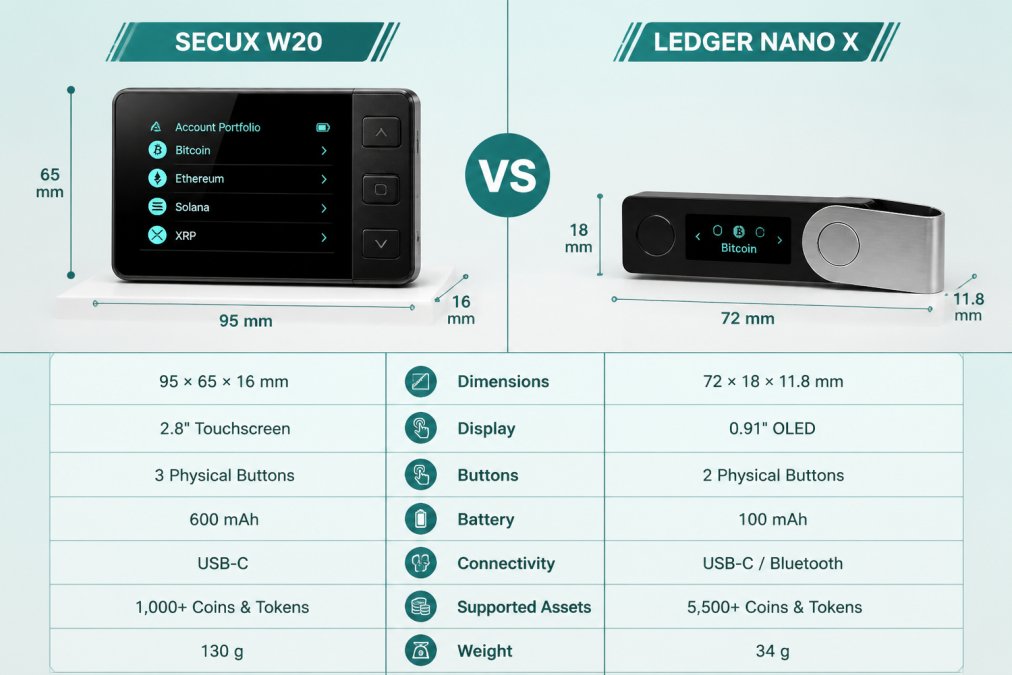
The W20 and Nano X are the closest competitors on price and capability, but all four current devices are worth comparing. Below is a model-by-model breakdown and the trade-offs that actually change the decision.
 SecuX W20View product
 Ledger Nano XView product
Display and interface
The SecuX W20 and V20 use a 2.8-inch color touchscreen with an on-screen keyboard, so you verify address and amount on a large display and confirm by tapping. The larger screen can help reduce misreading a truncated address.
The Ledger Nano X uses a small OLED screen with two physical buttons; the Nano S Plus uses a 1.1-inch monochrome OLED with the same scheme. You see less at once, but the button press is a deliberate physical confirmation. Neither approach is more secure in principle, both require on-device approval.
Connectivity and mobile support
SecuX W20 and V20 connect over Bluetooth and USB; the W20 is Android-only on mobile while the V20 adds iOS. Ledger Nano X connects over Bluetooth and USB-C with iOS and Android support; the Nano S Plus is USB-C only, no iOS.
On iPhone, your realistic options are the SecuX V20 or Ledger Nano X. Android-only or desktop-first users can use all four, with the W20 or Nano S Plus as value picks.

Storage capacity and app management
SecuX W20 and V20 expose a shared library of 1,000+ coins and tokens with no per-coin app installation. Ledger Nano X holds up to 100 coin apps at once; the Nano S Plus has less storage and supports 15,000+ assets through Ledger Wallet and compatible third-party wallets, but you'll swap apps if you hold many tokens.
For five to twenty assets, both are painless. Active traders juggling dozens of tokens may find less friction from SecuX's flat library; those wanting the broadest long-tail coverage get a larger catalog from Ledger. The trade-off is convenience versus breadth, not security.
Battery and portability
SecuX W20 and V20 have a rechargeable battery rated for roughly seven hours; the Ledger Nano X has a rechargeable battery, while the Nano S Plus is USB-powered with none. A battery matters on the go, not at a desk.
Price and what the extra dollars buy
SecuX W20 is $109.99, SecuX V20 $119.99, Ledger Nano X $99.00, and Ledger Nano S Plus $59.00. The $10 step from W20 to V20 buys iOS support and a rugged aluminum case; the $40 step from Nano S Plus to Nano X buys Bluetooth and iOS. The W20 sits $10 above the Nano X, trading iOS support for a larger touchscreen and no app management.
Decision framework by user type
- iPhone user who wants a big screen: SecuX V20 or Ledger Nano X. The V20 offers a larger display; the Nano X is priced competitively and has an established ecosystem.
- Android user with a diverse token portfolio: SecuX W20, no app juggling, large screen, Bluetooth.
- Desktop-only, budget-first: Ledger Nano S Plus, cheapest secure entry point, no mobile needed.
- Durability-focused traveler: SecuX V20, aluminum case and battery in a pocketable form factor.
Hardware Wallet Recovery Phrase and Backup Strategy
Both SecuX and Ledger generate a 12-, 18-, or 24-word recovery phrase during setup. That phrase is your backup: if the device is lost, stolen, or broken, you recover all funds with it on any compatible wallet.
Most people go wrong by storing the phrase insecurely.
SecuX supports BIP39 and BIP44 recovery standards, so you can recover funds on other wallets; Ledger uses industry-standard recovery too, so you're not locked into either brand's hardware.
Recovery is identical on both brands: get a new device, select "restore from recovery phrase," enter your words, and your wallet is restored with funds intact.
Price and Value Comparison
SecuX W20: $109.99 SecuX V20: $119.99 Ledger Nano X: $99.00 Ledger Nano S Plus: $59.00
The Ledger Nano S Plus is the cheapest entry point but lacks Bluetooth and iOS support, solid for desktop and Android only.
The SecuX W20 sits between the Nano X and V20 in price, with a larger touchscreen than Ledger, Bluetooth, and 1,000+ coin support without app management. The trade-off is no iOS support.
The SecuX V20 is the most expensive option but the most feature-rich SecuX model, adding an aluminum rugged case and slightly stronger build than the W20.
Which Wallet Should You Choose?
Pick the Ledger Nano X if you use an iPhone or want the most established brand. It works with iOS, has strong security credentials, and integrates with Ledger Live for staking and portfolio tracking.
Pick the SecuX W20 if you use Android, want a larger screen for easier transaction verification, and manage a diverse token portfolio.
Pick the Ledger Nano S Plus if you're budget-conscious and desktop-first.
Pick the SecuX V20 only if the W20 doesn't meet your needs and you want the premium SecuX experience, the aluminum case and stronger build justify the cost only for durability-focused users.
Conclusion
Choosing between SecuX and Ledger comes down to three factors: your phone type, how many tokens you hold, and whether you need Bluetooth. Both deliver the core promise of hardware wallets, private keys kept offline and secure from hackers.
At The Crypto Merchant, we're an authorized distributor for both SecuX and Ledger wallets, so every device we sell is verified authentic and secure before it reaches you. Whether you choose SecuX or Ledger, you're getting military-grade security and peace of mind for your digital assets. Shop Now and secure your cryptocurrency today.
Frequently Asked Questions
How does SecuX compare with Ledger for security?
Both SecuX and Ledger use secure element chips to protect private keys offline. SecuX devices feature military-grade secure elements (CC EAL 5+) with tamper-proof packaging and hidden wallet capabilities. Ledger Nano X uses a Secure Element chip with state-of-the-art protection and dual-chip architecture. Both employ PIN codes, recovery phrases, and offline transaction signing. The security architecture differs slightly: SecuX emphasizes hidden wallet features and on-screen address verification, while Ledger focuses on firmware integrity and U2F authentication. Both are considered highly secure for cold storage.
Which Ledger or SecuX wallet supports the most cryptocurrencies?
SecuX wallets support over 1,000 coins and tokens, including Bitcoin, Ethereum, ERC-20 tokens, and many altcoins. The Ledger Nano X can have up to 100 different coin applications installed simultaneously and supports thousands of assets through Ledger Live and third-party wallets. Ledger's 100-app limit means you can manage many currencies at once without frequent app swaps. Both offer extensive asset support for diversified portfolios.
What is a hardware wallet recovery phrase, and why does it matter?
A recovery phrase (also called a seed phrase) is a 12, 18, or 24-word sequence that regenerates your private keys if your wallet is lost or damaged. Both SecuX and Ledger wallets generate recovery phrases during setup. This phrase is critical because it's your only backup if the device fails. Store your recovery phrase offline on metal plates or paper in a secure location, never online. If someone gains access to your recovery phrase, they can access your cryptocurrency. Proper recovery phrase management is essential for long-term asset security.
Is a SecuX or Ledger wallet easier for beginners to use?
Both wallets are beginner-friendly, but they differ in setup and interface. SecuX W20 and W10 feature 2.8-inch touchscreens with on-screen keyboards and intuitive navigation. The Ledger Nano X has a smaller 0.96-inch display and integrates with the Ledger Live app. SecuX offers portability and ease of use out of the box, while Ledger offers software integration. Beginners should consider which ecosystem (SecuX's standalone design vs. Ledger Live's all-in-one platform) aligns with their workflow.


