

Table of Contents
- Ledger vs Trezor at a Glance: Security Comparison Table
- Ledger vs Trezor Open Source vs Closed Source: Two Security Philosophies
- Secure Element Chips vs Open Firmware: How Each Wallet Stops Attacks
- Physical Attack Resistance and Supply Chain Verification
- Privacy, Companion Apps, and Long-Term Firmware Support
- Hardware Wallet Security Best Practices for Any Device
- Pricing, Models, and Picking the Best Cold Storage Wallet 2026
- Frequently Asked Questions
Last Updated: September 30, 2026
Ledger vs Trezor at a Glance: Security Comparison Table
Ledger and Trezor are both hardware wallets that keep private keys offline, but they protect those keys in fundamentally different ways. Ledger starts at $99 on The Crypto Merchant and relies on a certified Secure Element chip. Trezor starts at $29 and builds its reputation on fully open-source firmware. This comparison from The Crypto Merchant breaks down where each approach wins.
The short answer: Ledger wins on chip-level hardware isolation and asset breadth, while Trezor wins on transparency and price. Neither is "more secure" in absolute terms. They defend against different threats, and the right pick depends on which threat worries you more.
Below, we'll show you exactly how each philosophy handles attacks, supply chain tampering, and long-term firmware support, plus what most buyers overlook about the human side of self-custody.
| Factor | Ledger | Trezor | Edge |
|---|---|---|---|
| Security model | Secure Element chip | Open-source firmware | Tie |
| Starting price | $99 | $29 | Trezor |
| Asset support | 15,000+ assets | Core coins, broad but narrower | Ledger |
| Mobile support | Bluetooth, iOS and Android | USB-C, Android web app | Ledger |
| Firmware transparency | Partially closed | Fully open | Trezor |
| Best for | Staking, DApps, mobile | Simple cold storage | - |
Ledger vs Trezor Open Source vs Closed Source: Two Security Philosophies
The core of the ledger vs trezor open source vs closed source debate comes down to one question: do you trust a certified chip, or do you trust code anyone can read? Ledger uses a Secure Element (SE) chip to isolate keys, while Trezor publishes its firmware for public review.
According to Ledger Academy's explanation of device architecture, Ledger verifies transactions through hardware isolation. Trezor's model, by contrast, lets security researchers audit every line of code.
Neither approach is wrong. A closed chip resists physical extraction better. Open firmware catches logic flaws faster because thousands of eyes can spot them. The trade-off is real, and it's the single biggest reason buyers split into two camps.
Secure Element Chips vs Open Firmware: How Each Wallet Stops Attacks
A Secure Element chip is a tamper-resistant microcontroller that stores private keys in a sealed environment, separate from the main processor. Trezor's open firmware instead relies on transparency and on-device confirmation to verify every transaction.
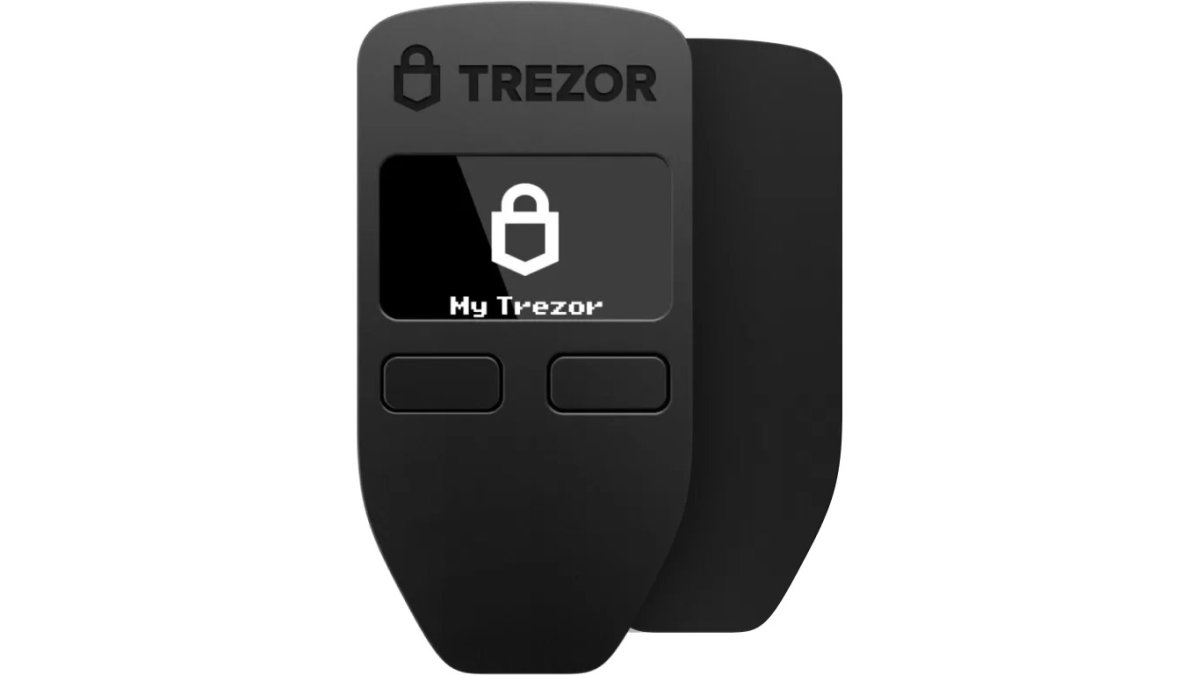
Ledger's dual-chip design means a compromised computer can't reach your keys. Trezor's Model One and Model T show full transaction details on screen so you confirm what you're actually signing.
 Trezor Model OneView product

Here's what most guides miss: an open firmware design doesn't mean weaker security. It means the security is verifiable. Trezor's Safe 3 and Safe 5 now pair open-source code with an EAL6+ Secure Element, effectively merging both philosophies into one device.
Physical Attack Resistance and Supply Chain Verification
Physical attacks target the gap between the factory and your desk. Both brands ship devices with tamper-evident packaging and a firmware integrity check at first boot, but the mechanisms differ in ways that matter if you ever lose possession of the device.
On-device physical defenses. Ledger's Secure Element is rated to resist side-channel and fault-injection attacks, the same class of tamper resistance used in payment cards and passports. The chip enforces a hard PIN attempt limit, after three wrong entries the device wipes its stored secrets, and the limit is enforced in silicon, not firmware, so it cannot be bypassed by flashing custom code. Trezor's Model One and Model T rely on a microcontroller without a Secure Element, which means a determined attacker with physical access and lab equipment can attempt extraction. Trezor's Safe 3 and Safe 5 add an EAL6+ Secure Element that brings them closer to Ledger's physical posture.
 Ledger Nano X PurpleView product

Supply chain attacks in the wild. The most documented real-world case is the 2021 Ledger data breach, where customer names, emails, and shipping addresses were exposed, not device keys, but enough for phishing and physical targeting of known hardware-wallet owners. Trezor has reported no comparable customer data breach, which is why privacy-focused buyers weight that history. Separately, resold or "pre-owned" wallets have arrived with pre-loaded seed phrases; the buyer funds the wallet and the seller drains it. This is the classic supply chain attack and it defeats the entire point of self-custody.
How to verify a device before you trust it. A genuine unit should arrive in sealed packaging with no seed phrase pre-written, no scratch-off recovery card, and no pre-generated PIN. On first boot, both Ledger and Trezor run a firmware integrity check against a signed image; if the check fails, stop and contact the manufacturer. Buy only from the manufacturer or an authorized reseller, marketplace listings and third-party "deals" are the primary vector for tampered units.
What happens if the device is lost or destroyed. This is the scenario most guides skip. The device itself is disposable, your funds live on the blockchain, and the recovery seed is the only thing that matters. If a Ledger or Trezor is lost, stolen, or physically destroyed, you restore the same wallet on a replacement device from either brand, or on a third-party wallet that supports the same BIP-39 or BIP-32 standard. Ledger and Trezor both use BIP-39 seed phrases, so a Trezor-generated seed can be restored on a Ledger and vice versa. That cross-brand compatibility is the real safety net, and it is worth testing once before you fund the wallet heavily. Write the seed on paper or metal, store it offline, and never photograph it.
Privacy, Companion Apps, and Long-Term Firmware Support
Companion software is where privacy usually leaks, and most hardware-wallet comparisons ignore it in favor of chip specs. Ledger Live and Trezor Suite both connect your device to a desktop or mobile app, and both can expose metadata that has nothing to do with your private keys: IP address, device model, firmware version, account balances, and the extended public keys (xpubs) that let a server map every address in your wallet.
Hardware Wallet Security Best Practices for Any Device
Hardware wallet security best practices apply no matter which brand you pick. The device only protects you if you follow the basics consistently.
- Buy only from an authorized reseller or the manufacturer
- Generate the seed phrase on the device, never accept a pre-written one
- Write the recovery seed on paper or metal, never store it digitally
- Set a strong PIN and enable the passphrase feature if you need plausible deniability
- Verify the receiving address on the device screen before every transaction
- Keep firmware updated through the official companion app only
- Test your recovery process once before you fund the wallet heavily
Pricing, Models, and Picking the Best Cold Storage Wallet 2026
Picking the best cold storage wallet in 2026 means matching the device to how you actually use crypto. Price is the least important variable once you're past the entry level.
| Model | Price | Security Approach | Best For |
|---|---|---|---|
| Trezor Model One | $29 | Open-source, two-button | First-time buyers, Bitcoin only |
| Trezor Model T | $59 | Open-source, touchscreen | Simple cold storage with a screen |
| Trezor Safe 3 | $79 | Open-source plus EAL6+ chip | Balanced security and price |
 Ledger Nano X |
$99 | Secure Element, Bluetooth | Multi-coin, mobile, staking |
| Trezor Safe 5 | $169 | Open-source plus EAL6+ chip | Premium cold storage, touchscreen |
Frequently Asked Questions
Which hardware wallet is more secure, Ledger or Trezor?
Neither wins outright. Ledger uses a Secure Element chip to isolate private keys, and the company reports no remote compromises of its devices. Trezor publishes 100% open-source firmware, so its code can be reviewed by anyone, and community reports point to no data breaches involving customer details. The right pick depends on whether you trust certified hardware isolation or public code review more.

Have Ledger wallets ever been hacked?
Ledger reports that its devices have not been compromised by remote hacks, even after physical security research by cybersecurity firms. Community reports do note three significant data privacy incidents in recent years, which involved customer information rather than wallet keys. Your private keys stay offline on the device, so leaked contact data does not by itself expose your crypto.
Is Trezor more secure than Ledger because its code is open source?
Open-source firmware lets researchers inspect the code and report flaws, which is a real advantage for trust. Trezor also now ships Secure Element protection on newer models like the Safe 3 and Safe 5, so the gap has narrowed. Ledger still leans on its certified Secure Element chip and closed firmware, verified through third-party audits instead of public review.
How do Ledger and Trezor protect against physical tampering?
Both require on-device confirmation before a transaction signs, so a compromised computer cannot move funds alone. Ledger devices use a Secure Element chip and tamper-evident packaging, while Trezor devices require your PIN and, on newer models, a device-entry passphrase. Buy from an authorized seller so the unit arrives sealed and verified rather than resold or opened.
What are the main security differences between Ledger and Trezor?
Ledger prioritizes hardware isolation through a Secure Element chip, supports over 15,000 assets, and offers Bluetooth on the Nano X for mobile use. Trezor emphasizes transparency with 100% open-source firmware and simple cold storage, and its Model One is listed with maintenance through at least 2031. Recovery, PIN protection, and on-device confirmation are shared across both brands.


