

Table of Contents
- Why Keep Crypto Assets Off Exchanges in 2026
- Custodial vs. Non-Custodial: What Changes When You Move Assets
- How to Transfer Crypto from Exchange to Wallet
- Best Hardware Wallets for 2026: What to Look For
- Securing Seed Phrases Offline: Steel Backups and Backup Verification
- Inheritance Planning and Emergency Recovery Drills
- Tax Implications of Self-Custody and the IRS View of Your Wallet
- Conclusion
- Frequently Asked Questions
Last Updated: October 2, 2026
Why Keep Crypto Assets Off Exchanges in 2026
Illicit crypto volume hit an all-time high of $158 billion in 2025, a 145% jump from the year before, according to TRM Labs 2026 Crypto Crime Report. That number matters because most of it flowed through centralized platforms. At The Crypto Merchant, we've watched this shift push more investors toward self-custody. Learning how to keep crypto assets off exchanges is now basic risk management, not a paranoid habit.
- Exchanges pool customer funds in shared wallets
- A single breach can expose every account at once
- Withdrawals can freeze during market chaos
- You depend on a company's solvency, not your own
Custodial vs. Non-Custodial: What Changes When You Move Assets
Non-custodial storage means you hold the private keys; custodial storage means a third party does. That difference decides who can move your funds.
- Control. Only your keys can sign a transaction.
- Responsibility. Lose your recovery phrase, and no support line can restore it.
- Access. No one can freeze your account, including you.
Neither option is "safe." They just fail differently.
How to Transfer Crypto from Exchange to Wallet
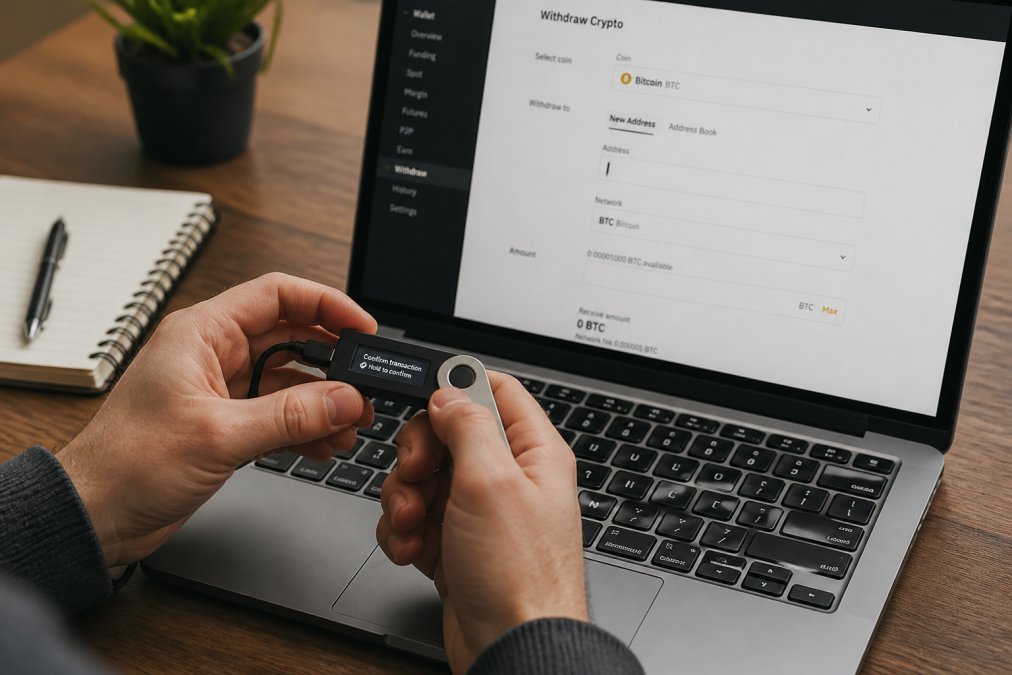
A transfer takes about 10 to 30 minutes once your wallet is set up, and these steps work for any major exchange and hardware wallet.
Step 1: Generate a Receive Address on Your Hardware Wallet
Plug in your wallet, open its companion app, select the asset you're moving, and choose "Receive." The device displays the address on its own screen, copy it from there, not your computer. Malware can swap an address on your clipboard, and checking the device screen catches that.
 SecuX W20View product
Step 2: Initiate the Withdrawal and Confirm Network Details
Paste the address into your exchange's withdrawal page. Then match the network.
- Sending USDC on Ethereum? The receiving wallet must expect Ethereum.
- Wrong network usually means permanent loss.
- Start with a small test amount first.
Best Hardware Wallets for 2026: What to Look For
The best hardware wallet for 2026 keeps your keys offline, shows transaction details on its own screen, and supports the coins you hold. Price matters less than these three basics.
Here's what to compare:
| Wallet | Price | Best For | Standout Feature |
|---|---|---|---|
 Trezor Model One |
$29.00 | First-time buyers | On-device OLED confirmation |
| Ledger Nano X | $99.00 | Mobile users | Bluetooth and 100+ coin apps |
| BitBox02 Multi | $149.99 | Privacy-focused users | microSD seed backup |
| Billfodl Steel Backup | $99.99 | Seed phrase protection | Fire and water proof steel |
The Supply Chain Problem Nobody Talks About
Where you buy the device matters as much as which device you buy: a hardware wallet is only trustworthy if it reaches you untampered. A reseller, or anyone in the shipping chain, can open a sealed box, pre-load a seed phrase, reseal it, and ship it. Restore that pre-loaded seed instead of generating your own, and the attacker holds your keys from day one.

A few practical defenses:
- Buy direct or from an authorized distributor. Manufacturer storefronts and vetted authorized resellers are the only channels with a documented chain of custody. Marketplace listings from unknown sellers are the highest-risk source.
- Inspect the packaging. Look for intact tamper-evident seals, holographic stickers, and shrink wrap matching the manufacturer's spec. A resealed box often shows mismatched tape or a broken seal.
- Generate your own seed on first boot. A legitimate new device asks you to create a new wallet and write down a fresh seed. If a device arrives with a seed phrase already written on a card in the box, do not use it, the single clearest red flag.
- Verify firmware before funding. Connect the device to the official companion app and let it check the firmware signature. Never install firmware from an email link or third-party site.
- Check the serial number. Most manufacturers publish a way to confirm a device's authenticity. Use it before moving any meaningful balance onto the wallet.
How to Evaluate Any Wallet Before You Buy
Run every candidate through this checklist:
- Does it have a screen and physical buttons? You need to read the address and amount on the device itself, not your computer.
- Does it support your specific assets? Coin support varies widely. Confirm the exact tickers you hold are on the compatibility list.
- Is the firmware open to review or independently audited? Transparency about the code is a meaningful trust signal.
- Can you recover without the company? Your seed phrase should restore your funds on a compatible wallet even if the manufacturer disappears.
- Is there a documented authenticity check? A serial number lookup or firmware signature check confirms the device is genuine.
One honest limitation: every wallet needs a backup plan. The device can fail; your seed phrase is what saves you.
Securing Seed Phrases Offline: Steel Backups and Backup Verification
Your seed phrase is the master key to everything you own. Store it offline, on steel, and verify it works before you need it, paper burns, floods, and fades.
Trezor Model One Hardware Wallet →
- Record all 12, 18, or 24 words on a metal plate
- Keep it somewhere fire and water can't reach
- Never photograph it or type it into any device
- Never store it in cloud notes or email
The Failure Modes You're Actually Defending Against
Name the threats, because each calls for a different defense:
- Fire and flood. Paper and most plastics don't survive. Stamped or engraved metal does.
- Loss or misplacement. A single copy in one place is a single point of failure. Consider a second copy in a separate, secure location.
- Theft. Anyone who finds your seed can drain your wallet instantly. Obscure the location and don't label it "crypto seed."
- Transcription error. One wrong word out of 24 makes the whole phrase useless, the most common silent failure.
- Coercion. If someone knows you hold crypto, a seed phrase in your home is a physical risk. Some holders split the phrase across locations so no single site holds the full key.
A seed phrase stored in a photo, a password manager, or an email draft is not offline. Cloud accounts get breached, and a synced note is reachable from any device that logs into your account.
How to Verify a Backup Before You Need It
A backup you've never tested is a guess, not a plan. Run this drill in about 30 minutes:
- Pick a spare or secondary device. Use a compatible hardware wallet you're not currently relying on, or a reputable software wallet on an air-gapped or freshly reset machine.
- Choose the restore option. Select "Restore wallet" and enter your seed phrase word by word, exactly as written on your backup.
- Confirm the addresses match. After restore, the wallet should generate the same receiving addresses as your primary device. If they differ, your backup is wrong or incomplete.
- Check the balance. If your funds appear, the backup works. If the wallet is empty, stop, do not move more assets until you've resolved the discrepancy.
- Wipe the test device. Once verified, reset the spare device so the seed isn't sitting on a second machine.
A Recovery Drill for the People Who'd Have to Use It
Verifying your own backup proves the phrase works. It doesn't prove anyone else could use it, the gap most guides leave open.
- They don't know which wallet app or device to use.
- They can't find the backup, or don't recognize the format.
- They don't know the word order matters, or that some wallets use a passphrase on top of the seed.
- They don't know how to check whether the restore succeeded.
Inheritance Planning and Emergency Recovery Drills
Most crypto owners have no plan for what happens after they die, the gap that costs families everything.
Build a plan that covers three things:
- Access instructions. Write down which wallets you use and where the backups live. Do not write the seed itself in the same document.
- A trusted person. Name someone who knows the plan exists and how to start it.
- Legal alignment. Talk to an estate attorney about how your state treats digital assets.
Tax Implications of Self-Custody and the IRS View of Your Wallet
Moving crypto to your own wallet is not a taxable event. The IRS treats a transfer between wallets you control as a non-event, because you haven't sold or disposed of anything.
What does trigger tax:
- Selling crypto for cash
- Trading one coin for another
- Paying for goods or services with crypto
Conclusion
The hardest part of self-custody isn't the transfer. It's the discipline that follows: protecting a seed phrase, testing backups, and planning for the day you can't access your own wallet.
Frequently Asked Questions
Is it safe to leave crypto on exchanges?
Leaving crypto on exchanges means you hold an IOU, not the asset itself. TRM Labs reports illicit crypto volume hit $158 billion in 2025, up nearly 145% from 2024, even as exchange-linked illicit activity fell about 30%. Yale researchers note centralized exchanges often have limited integration with the global banking system, which can complicate access during stress events. Security.org's 2026 guide recommends moving assets into a private, self-hosted wallet as the most effective protection. Hardware wallets from The Crypto Merchant keep private keys offline.
How do I move crypto off an exchange?
Generate a receive address on your hardware wallet, copy it exactly, and paste it into the exchange's withdrawal screen. Confirm the network matches (for example, Bitcoin to Bitcoin, or ERC-20 to Ethereum). Send a small test amount first, verify it appears in your wallet, then send the remainder. Expect a transfer fee set by the network. Never type the address by hand; use copy-paste or a QR code to avoid mistakes. After confirmation, your crypto assets off exchanges sit under your own keys.
What is the difference between a hot wallet and a cold wallet?
A hot wallet connects to the internet, usually through a phone or browser, so it is convenient for small, active balances but exposed to phishing and malware. A cold wallet, such as a hardware wallet, keeps private keys offline and requires on-device confirmation for every transaction. The Trezor Model One ($29.00) and Ledger Nano X ($99.00) both display transaction details on a built-in screen so you approve transfers physically. For long-term holdings, cold storage is the standard approach.
Can the IRS see your crypto wallet?
The IRS can see transactions tied to your identity through exchange records, since exchanges file information returns and report customer activity. A self-custody wallet's public address is pseudonymous, not invisible: blockchain analysis can link addresses to known entities. The SEC proposed new rules in March 2026 (Press Release 2026-76) clarifying how federal securities laws apply to certain crypto assets, which increases reporting expectations. Keep records of every transfer, cost basis, and date for tax filing.


