

Last Updated: November 1, 2026
Quick Summary
Secure your seed phrase with tamper-evident bags by sealing the physical backup inside, signing and dating across the seal, and recording the bag's serial number in a separate location. Choose a bag that fits your paper or metal backup with at least half an inch of clearance on each side. Inspect the seal monthly or quarterly, and treat any disturbance as exposure.
- Measure your backup first, then add at least half an inch of clearance on each side.
- Press out as much air as possible before sealing to reduce moisture and movement.
- Sign and date across the seal so any later opening disturbs your signature.
- Keep the serial-number record in a different location from the bag itself.
- The Coinkite kit lists a 10.5 x 6 inch internal bag size for larger backups.
Table of Contents
- Why a Seed Phrase Backup Needs Tamper Evidence
- Seed Phrase Storage: Paper, Laminated, or Metal
- Choosing the Right Tamper-Evident Bags
- Step by Step: Folding, Sealing, and Signing the Bag
- How to Protect a Seed Phrase From Theft With Offline Storage
- Metal Seed Phrase Backup: What Fits Inside the Bag
- Where to Store the Sealed Bag and How to Inspect It
- What Tamper-Evident Bags Cannot Do
- Frequently Asked Questions
 Ledger BillfodlView product
Why a Seed Phrase Backup Needs Tamper Evidence
A tamper-evident bag is a sealed security pouch that shows visible signs if someone opens it.
Here is the core problem. Your recovery phrase controls the wallet. Anyone who reads those words owns the funds.
A tamper-evident seal answers that second question. Break the seal, and the bag shows it.
- Detect: a broken or cut seal is visible on inspection
- Deter: a thief knows the intrusion will be noticed
- Document: a recorded seal number ties one bag to one backup
The CISA guidance on protecting sensitive data makes the same point about physical controls: detection matters as much as prevention.
Seed Phrase Storage: Paper, Laminated, or Metal
Paper, laminated paper, and metal are the three common backup mediums, and each trades cost against durability. Paper is cheap and easy but fragile. Lamination adds water resistance. Metal survives fire and flooding but costs more and takes effort to stamp.
Here is how they compare in practice:
| Medium | Cost | Fire | Water | Best For |
|---|---|---|---|---|
| Paper | Lowest | No | No | Quick, temporary backup |
| Laminated paper | Low | No | Yes | Budget long-term storage |
| Stamped metal | Higher | Yes | Yes | Long-term, high-value holdings |
A common mistake is storing a paper backup in a damp basement or a hot attic. Both destroy ink and card stock over time.
Metal seed phrase backup plates are a durable option. Whether a given plate fits inside a security bag depends on its dimensions, which we cover below.
 BitBox02View product
Choosing the Right Tamper-Evident Bags
Pick a bag that fits your backup, seals with a strong adhesive, and carries a unique serial number. Size matters most: a bag too small for a metal plate forces you to fold or damage the backup, and a bag too large lets the contents shift and abrade against the seam.
Selection criteria that actually matter
- Interior dimensions with clearance. Measure your backup first, then add at least half an inch on each side. A stamped metal plate with sharp corners needs more clearance than a folded paper card.
- Seal type. Look for a full-width adhesive strip plus a security seam, not a single glue line. A partial seal is the most common failure point.
- Serial number. A unique, printed serial number is what lets you tie one bag to one backup in your records. Bags without a serial number are harder to audit.
Bag compatibility with paper and metal backups
| Backup medium | Fit notes | Watch for |
|---|---|---|
| Paper card | Fits most bags with room to spare | Creasing along the fold; ink transfer if sealed before fully dry |
| Laminated paper | Fits, but lamination adds stiffness | Sharp laminated corners can nick foil; leave clearance |
| Stamped metal plate | Needs a larger interior; check dimensions | Sharp edges; wrap in an ESD bag or soft sleeve first |
| Metal plate plus hardware wallet | Needs the largest bag in the lineup | Bulging the seam; use a bigger bag rather than forcing the seal |
A snug fit with a little room to spare is ideal. If the plate bulges the seam, use a bigger bag rather than forcing the seal.
Privacy: what should never appear on the exterior
This is where most guides stop short. The bag exterior is the most visible part of your backup, so treat it as public-facing.
- Never write a wallet address, seed words, or a derivation path on the bag.
- Never write your name, address, or the location of the backup on the bag.
- Use a neutral label, a bag number or a short code, that only means something when matched to your separate record.
A common pattern is to label the bag with a short code (for example, "B-01") and keep the matching record, serial number, date sealed, backup medium, and storage location, in a separate secure place. That way a person who finds the bag learns nothing useful from the exterior alone.
Options that fit this job
We stock two options at The Crypto Merchant, and both handle this job well. The BitBox Tamper-Evident Bags 5 Pack gives you five bags with a seal, security seams, and tear-resistant foil. The bag's listing describes it as transparent, so you can check contents without opening it.

If you want a fuller kit, the Coinkite Security Bag Kit bundles three opaque tamper-evident bags, four recovery cards, and two ESD bags. The internal size is 10.5 x 6 inches, which fits larger backups and a hardware wallet.

Best for: most users, the BitBox 5-pack at $14.99 for its clear window and low cost. Skip if: you need opaque bags and recovery cards together, where the Coinkite kit at $24.99 fits better.
Step by Step: Folding, Sealing, and Signing the Bag
Follow these steps in one sitting, on one clean surface, with no phone nearby. The goal is a sealed, signed bag with a recorded seal number you can check later, and a record that reveals nothing if someone finds it.
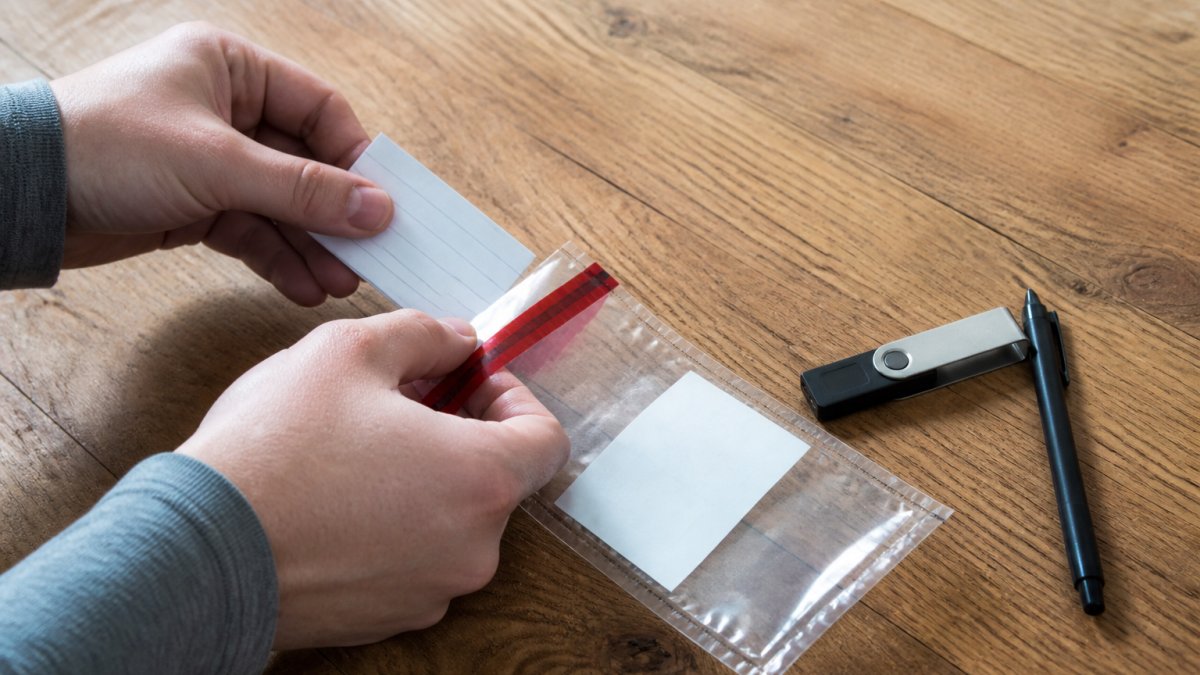
Step 1: Prepare the backup and a flat surface
Clear a flat, dry table and remove cameras and phones from the room. Write or stamp your seed words, then let ink dry fully, sealing a damp card traps moisture against the paper. Fold the backup once, gently, so it slides in without creasing the words. If you are using a metal plate, wrap it in an ESD bag or soft sleeve before it goes anywhere near the foil.
BitBox Tamper-Evident Bags 5 Pack →
Step 2: Seal the bag and control the air
Slide the backup into the bag and press out as much air as you can. Less air means less moisture inside and less movement against the seam. Peel the adhesive strip, fold the top over, and press the seam firmly along its full length, corners included, since a lifted corner is the easiest place to start an opening.
Step 3: Sign, date, and record the seal number
Sign and date across the seal so any later opening disturbs your signature. Write down the bag's seal number and keep that record somewhere separate. Tear off the receipt strip if your bag has one and store it apart from the bag.
When you record the bag, log only what you need to audit it later:
- Bag serial number
- Date sealed
- Backup medium (paper, laminated paper, or metal)
Do not log the seed words, a wallet address, or a derivation path in the same record. If that record is found, it should not help anyone reach the funds.
Step 4: Do a safe recovery test before you rely on it
A sealed bag you have never verified is an assumption, not a backup. Before you store the bag long-term, confirm the backup is readable and correct, but do it without exposing the phrase to a camera or an internet-connected device. If you open the bag to test, treat the old bag as spent and replace it.
How to Protect a Seed Phrase From Theft With Offline Storage
Offline storage means the seed phrase never touches an internet-connected device. To protect a seed phrase from theft, keep every copy physical and every location private.
- Never type seed words into a computer, phone, or website
- Never photograph or scan the backup
- Never email it or store it in cloud notes
The FBI guidance on cryptocurrency scams repeatedly flags remote access and phishing as leading causes of crypto loss. A sealed, offline backup sidesteps both.
Metal Seed Phrase Backup: What Fits Inside the Bag
The Coinkite kit lists a 10.5 x 6 inch internal bag size. Check your plate's dimensions against the bag size before you seal.
Watch the corners. Sharp metal edges can nick the foil, so wrap a plate in the included ESD bag or a soft sleeve first. A snug fit with a little room to spare is ideal. If the plate bulges the seam, use a bigger bag rather than forcing the seal.
Where to Store the Sealed Bag and How to Inspect It
Store the sealed bag in a safe, a locked cabinet, or a safe deposit box, and keep your seal-number record somewhere else. Splitting the bag and the record means a thief who finds one still lacks the other.
Inspect the bag on a set schedule, monthly or quarterly. Look for:
- A cut, stretched, or lifted seal
- A signature that no longer lines up
- A seal number that does not match your record
If a seal is disturbed, treat the seed phrase as exposed. Move your funds to a new wallet with a fresh seed phrase right away, then reseal the new backup. Do not wait to confirm a theft.
What Tamper-Evident Bags Cannot Do
A tamper-evident bag detects access. It does not prevent it. That distinction matters, because overestimating the bag leads to weak storage choices elsewhere.
- It cannot stop a determined thief from cutting the bag
- It cannot stop someone who reseals with a matching bag and forged number
- It cannot protect a seed phrase left in plain sight or shared carelessly
The threat model is simple: the bag buys you detection and time, nothing more.
Securing a seed phrase is really a test of discipline: one clean surface, one sealed bag, one recorded number, and a routine you actually keep.
Frequently Asked Questions
Do tamper-evident bags protect a seed phrase from theft?
They do not physically stop a thief. What tamper-evident bags do is make access visible. If someone opens the bag to photograph or copy your seed words, the seal, security seams, or foil show it. That turns a silent compromise into something you can detect and respond to by moving funds to a new wallet with a fresh recovery phrase. Treat the bag as an alarm, not a lock, and pair it with a safe, a hiding place, or a safe deposit box.
How can you tell if a tamper-evident bag has been opened?
Check the seal, the seams, and the foil for tears, stretching, or residue, then compare the seal number and your signature against the receipt you stored separately. BitBox Tamper-Evident Bags use a seal with security seams and tear-resistant foil, and the Coinkite Security Bag Kit includes three opaque tamper-evident bags. Any mismatch between the bag in front of you and your record means you should assume the backup was exposed.
Should you store a seed phrase in a tamper-evident bag or a fireproof safe?
If the safe is opened without your knowledge, the disturbed seal tells you. Neither item protects a seed phrase on its own, so keep a second copy in a separate location and test recovery before you rely on either.
Can a tamper-evident bag protect a seed phrase from water or fire?
Only partly. The BitBox bag listing describes protection against heat, freezing, and solvents, and pressing out excess air helps keep moisture out. That helps with a damp basement or a spilled drink, but a bag is not a fire safe. For fire and flood risk, combine a metal seed phrase backup with the bag and store the sealed bag inside a rated safe or a safe deposit box.


