

Last Updated: October 30, 2026
Quick Summary
Tamper evident bags are a low-cost way to show whether someone has opened a hardware wallet or seed phrase backup, but they only reveal tampering and do not prevent it. The best choice depends on seal type, bag material, opacity and environmental resistance. Use them together with a metal or secure backup and a regular inspection schedule.
- Tamper evident bags reveal physical access but do not encrypt contents or stop copying.
- Void-message seals show a hidden word in the adhesive residue once the seal is disturbed.
- Substitution of an identical bag is a common attack, so record each bag's serial number.
- Multi-layer foil or metallized laminates resist puncture better than plain polyethylene.
- Never store the seed phrase digitally, and check the seal on a set schedule against your log.
Table of Contents
- What Tamper-Evident Bags Can and Cannot Protect
- How Seal Types and Evidence of Tampering Differ
- Comparing Bag Material, Closure and Environmental Performance
- How to Store a Crypto Seed Phrase Inside a Tamper-Evident Bag
- Hardware Wallet Recovery Phrase Backup Options Compared
- Metal Seed Phrase Backup Versus Tamper-Evident Bags
- Seed Phrase Security Best Practices for Your Next Packing Session
- Frequently Asked Questions
Tamper evident bags are a cheap way to know whether someone has opened your hardware wallet or seed phrase backup. But they are only one layer of protection, and the choice between bag materials, closures and seal types matters less than most guides suggest. This guide from The Crypto Merchant compares the main options, explains what each one can and cannot do, and shows how to pack a seed phrase so the bag actually helps.
 Ledger Nano X PurpleView product
What Tamper-Evident Bags Can and Cannot Protect
A tamper-evident bag is a physical-access indicator. It shows whether someone opened or tampered with what is inside. It does not encrypt anything, and it does not stop a determined person from copying your recovery phrase if they can get to it.
That distinction matters. They are not a substitute for a secure wallet. Wallet security depends on custody model, key storage and how the device handles threats, which is a separate question from what the bag does.
Think of the bag as a witness, not a guard. It tells you something happened. It does not prevent it.
How Seal Types and Evidence of Tampering Differ
To compare tamper evident bags, it helps to know which seal mechanism you are looking at and what each one does when someone opens it. There are four common seal families, and they fail in different ways.
Destructible (frangible) adhesive seals. The seal is designed to tear apart rather than peel cleanly, leaving residue when opened. This is a common mechanism in security bags, and it is one to look for if your main concern is undetected opening. The weakness: a patient person with a heat source can sometimes soften the adhesive and lift the seal with less tearing than intended, which is why destructible seals are usually paired with a serial number and a void message.
Void-message seals. These carry a hidden word or pattern (often "VOID" or "OPENED") that is invisible until the seal is disturbed, at which point the message appears in the adhesive residue. The advantage is that the evidence is unambiguous, you do not have to judge whether a peel looks suspicious, because the seal tells you. The trade-off is that void seals are only as good as their adhesive; a seal that lifts without releasing the message provides no evidence at all.
This does not detect tampering by itself, but it defeats substitution, the most common attack on a tamper-evident bag is not opening it, it is swapping the whole bag for an identical one. Without a recorded serial number, a swapped bag is invisible.
Security seams and closure indicators. Many bags add heat-sealed or stitched seams that distort, stretch, or show stress whitening when the bag is pried open. These are secondary indicators; they supplement the seal but rarely stand alone.
A few practical checks that separate a real comparison from a generic one:
- Peel test on a spare bag. Before you trust any brand, seal an empty bag, let the adhesive cure for a day, then open it slowly to see how the seal fails.
- Seam inspection. Look for stretch marks, whitening, or distortion along the seams, especially near the closure.
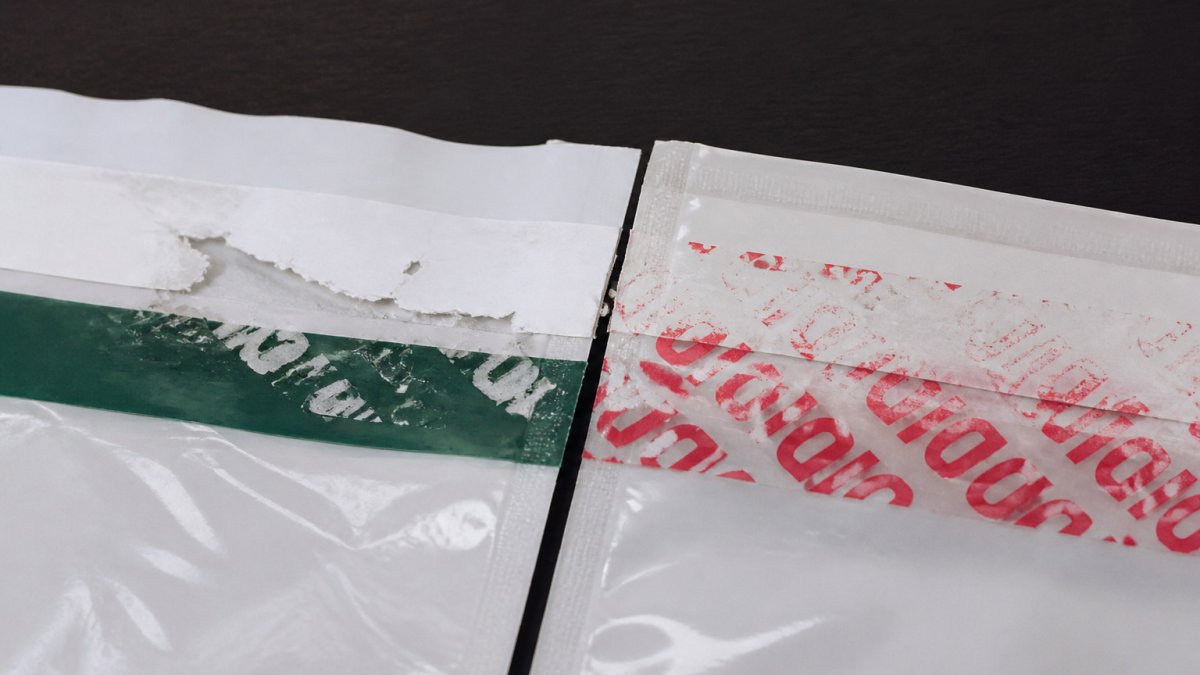
The main seal families behave differently when someone opens them, so it helps to compare them side by side.
| Seal type | How it fails | Main weakness |
|---|---|---|
| Destructible (frangible) adhesive | Tears apart and leaves residue | Heat can lift it with less tearing |
| Void-message seal | Hidden word appears in residue | Useless if adhesive lifts cleanly |
| Security seams and closure indicators | Stretch marks, whitening, distortion | Rarely stand alone as evidence |
 Ledger Nano S PlusView product
Comparing Bag Material, Closure and Environmental Performance
Material and closure decide whether a bag still provides evidence after months in a garage, a safe, or a safe-deposit box. Compare bags on five criteria, not on marketing language.
1. Material and puncture resistance. Most security bags use multi-layer foil or metallized film laminates rather than plain polyethylene. The laminate resists puncture and abrasion better than a single film, and the foil layer blocks casual visual inspection from outside. A plain clear polyethylene bag is easy to read through and easy to slice, fine for organizing, weak as a tamper indicator. Ask what the laminate is and how many layers it has; a bag that cannot answer that is a commodity bag.
2. Opacity. Opaque or metallized bags hide contents from anyone handling the package in transit or in storage. Transparent bags let you confirm contents without opening, which is convenient for quick inspections but exposes the wallet and backup to anyone who can see the bag. The trade-off is real: transparency aids your own audit, opacity aids confidentiality. Many practitioners use an opaque outer bag with a transparent inner sleeve so both needs are met.
3. Closure reliability. Fold-over adhesive tops with a destructible seal are harder to reopen without evidence than zip closures, which can be resealed and even re-zipped after a slit. If a bag uses a zip closure, confirm it also has an adhesive security flap, a zip alone is not tamper-evident. Mastering the nuances of detecting resealed packaging remains a critical skill for anyone securing high-value assets against sophisticated physical intrusion.
4. Environmental performance. Heat, freezing, and solvent exposure degrade adhesives and laminate films. A bag rated for temperature swings belongs in an unconditioned space like a garage or basement; a bag with no rating belongs in a climate-controlled interior. Remove as much air as possible before sealing to limit moisture condensation inside the bag, and avoid storing sealed bags directly on concrete, which wicks moisture.
BitBox Tamper-Evident Bags 5 Pack →
5. Readability and handling. A seal you cannot read after six months is not evidence. Check that the serial number and any void message remain legible after folding, stacking, and handling, and that the bag lies flat so the seal is not creased by contents pressing against it.
A transparent rubric makes the comparison honest. Score each bag from 1 to 5 on seal integrity (does it tear and leave residue?), adhesive failure mode (does it lift cleanly?), serial readability after storage, moisture and temperature resistance, and puncture resistance. A bag that scores well on seal integrity but poorly on readability is a bag you will not be able to audit later.
How to Store a Crypto Seed Phrase Inside a Tamper-Evident Bag
Pack the bag on a flat surface so the seal lies flat and the contents do not press against it.
- Place the hardware wallet, any steel backup plate and the paper or metal seed phrase record into the bag.
- Remove as much air as possible, then expose the adhesive.
- Fold over the top and press the seal firmly.
- Tear off the receipt portion and store it separately, along with a note of the date.
- Check the seal on a set schedule and compare it against your written record.
Watch out: never write your seed phrase on the same paper as your receipt log or photograph it with a phone that syncs to cloud storage. A bag does nothing if the phrase is already exposed elsewhere.
Hardware Wallet Recovery Phrase Backup Options Compared
Recovery phrase backups fall into two main groups: paper and metal. Paper is inexpensive and easy to create, but it degrades with moisture, fire and handling. Metal is more durable, but it takes more effort to produce. A titanium stamping kit lets you engrave your seed words yourself.
Tamper-evident bags can be used with either. A paper backup in a sealed bag gains some protection against undetected reading.
The BitBox Tamper-Evident Bags 5 Pack are priced at $14.99 at The Crypto Merchant.
Metal Seed Phrase Backup Versus Tamper-Evident Bags
Metal backups and tamper-evident bags solve different problems. You can compare a titanium seed plate directly against bag-based storage. A metal plate protects the recovery phrase against fire, water and time. A tamper-evident bag tells you whether the phrase has been accessed. Many people use both.
If you are choosing one, consider your main risk. Someone worried about disaster damage will get more from a metal backup. Someone worried about people getting into a home or storage space will benefit more from a bag that reveals tampering.
Seed Phrase Security Best Practices for Your Next Packing Session
Before you seal anything, confirm three things:
- Your recovery phrase is written correctly and has been checked against your wallet.
- No digital copy exists on a phone, computer or cloud service.
- The bag contains only what it should, and the receipt log is updated.
Keep the sealed bag somewhere with stable temperature and limited access. Avoid storing it in a vehicle, near a heat source or in a place where many people have keys. Review the seal on a set schedule, and treat any broken seal as a reason to move funds to a new wallet and new recovery phrase.
The Crypto Merchant also sells hardware wallets from brands including Ledger, Trezor and SecuX. You can browse all hardware wallets and accessories in one place.
Frequently Asked Questions
Do tamper-evident bags protect crypto seed phrases?
Tamper-evident bags help reveal whether someone has physically accessed a seed phrase backup, which is useful when you store it somewhere you cannot watch constantly. They do not hide the words, and they do not stop a person from reading or photographing the backup if they open the bag without leaving obvious evidence. A bag is one layer of a broader plan. Pair it with a secure storage location, a clear record of when you sealed it, and regular inspections for signs of disturbance.
Can a tamper-evident bag prevent someone from copying a seed phrase?
No. A tamper-evident bag is designed to show that the seal was broken or the bag was opened, not to prevent that access. Someone who gets to the bag can read the seed phrase, and a well-executed opening may leave the seal looking intact. Physical access to the phrase is the core threat these bags address only partially. If your main concern is someone viewing or copying the words, the phrase should not sit in an accessible location in the first place.
Are tamper-evident bags better than metal seed phrase backups?
They solve different problems. Tamper-evident bags are inexpensive and reveal some physical access, but paper inside them can still be damaged by water, fire or time. Metal seed phrase backups are built to resist heat, water and wear, but they do not show whether someone has viewed the words. Many people use a metal backup for durability and a sealed bag for detection, keeping the metal plate inside the bag so both protections apply.
How often should you inspect a tamper-evident bag?
Inspect the bag on a set schedule, such as every few months, and check it immediately after any event that could mean someone has been in the storage area. Look at the seal, the security seams and the receipt or log you kept for that bag. Compare what you see with your written record. If anything looks different, treat the seed phrase as potentially exposed and move funds to a new wallet generated from a new phrase.
Ready to seal your backup? Browse BitBox tamper-evident bags and the full range of hardware wallets and accessories at The Crypto Merchant.


