

Table of Contents
- Why Your Seed Phrase Is the Master Key to Your Crypto
- What You'll Need Before You Start
- Step 1: Write Down Your Recovery Phrase and Verify Every Word
- Step 2: The Best Way to Store a Seed Phrase Is Offline
- Step 3: Choose a Metal Seed Phrase Backup for Physical Durability
- Step 4: Pick a Storage Location and Separate Your Backup Copies
- Step 5: Avoid These Seed Phrase Security Mistakes
- Step 6: What to Do If Your Seed Phrase Is Compromised
- Frequently Asked Questions
Last Updated: October 15, 2026
Why Your Seed Phrase Is the Master Key to Your Crypto
Your seed phrase is the 12 to 24 word backup that restores full access to every wallet you own. Lose it and your crypto is gone.
A seed phrase (also called a recovery phrase) is a human-readable list of words that rebuilds your private keys on any compatible wallet. It is not a password you can reset.
That single fact changes how you should treat it. A 2025 study in the ACM Digital Library on seed phrase misunderstandings found that many users misunderstand how seed phrases work, which leads to avoidable losses.
This guide shows you how to protect crypto seed phrases in seven steps, from writing them down to handling a suspected leak.
What You'll Need Before You Start
Gather your supplies before you touch your wallet. Working from a checklist keeps you from rushing.
Here is what to have ready:
- Your hardware wallet and its recovery phrase
- A pen and two sheets of acid-free paper
- A metal seed phrase backup device
- A private room with no cameras or phones nearby
- A second secure location for one backup copy
Do not photograph your phrase. Do not type it into a computer. According to BitPay's guide to securing a seed phrase, recovery phrases should stay offline and never be shared with anyone.
Set aside 30 minutes. Rushing is how mistakes happen.
Step 1: Write Down Your Recovery Phrase and Verify Every Word
Write each word by hand, in order, on paper. Then check it twice.
Word order matters. A single swapped word makes the whole phrase useless. Print clearly, since legible handwriting is the only thing standing between you and a failed recovery years from now.
Follow these rules:
- Number each word as you write it
- Use the exact spelling your wallet shows
- Read the full list back against the screen
- Have a second person read it aloud while you check
Never store the phrase as a screenshot, a text file, or a note in your phone. Those copies live in places hackers can reach.
Step 2: The Best Way to Store a Seed Phrase Is Offline
The best way to store a seed phrase is offline, on a physical medium that no hacker can reach over the internet.
Digital storage fails for one reason: anything connected to the internet can be copied without your knowledge.
A common mistake is treating a password manager as safe storage. It is not built for a phrase that grants total control of your funds.
So the rule is simple: keep every copy offline, and keep more than one.
Step 3: Choose a Metal Seed Phrase Backup for Physical Durability
A metal seed phrase backup outlasts paper against fire, water, and impact. Paper burns, fades, and tears. Stamped steel does not.
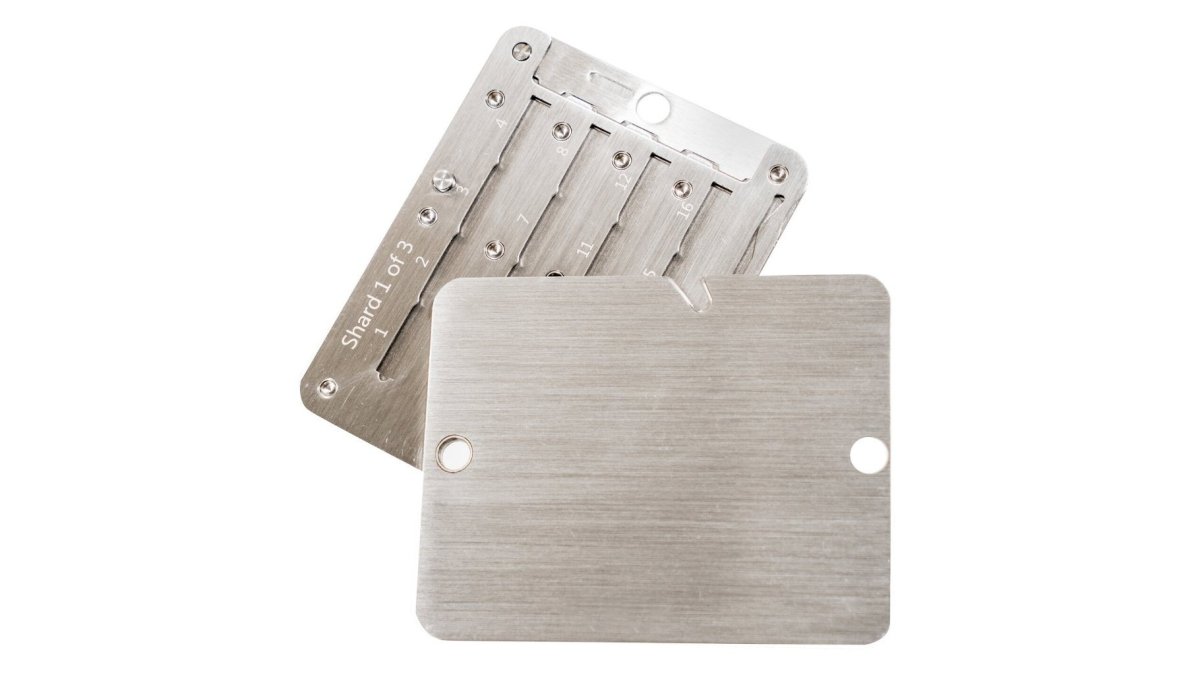
This is where most setups quietly fail. A house fire or a burst pipe can destroy a paper backup in seconds, and you will not know until you try to recover.

A metal backup device stores your words on stainless steel. Options worth considering:
| Backup Tool | Price | Words Supported | Best For |
|---|---|---|---|
| BitBox SteelWallet | $64.99 | Up to 24 | Low-cost steel starter kit |
 Ledger Billfodl |
$99.99 | 12, 18, or 24 | Fire, water, and shock resistance |
| Trezor Keep Metal | $99.00 | 24 | Tamper-evident seals |
| Billfodl Multishard | $235.00 | 24, split into 3 shards | 2-of-3 style recovery |
The Ledger Academy guide to keeping a seed phrase secure also describes splitting a phrase into parts and storing them apart.

Step 4: Pick a Storage Location and Separate Your Backup Copies
Store your backups in separate, secure places, not side by side. Redundancy only helps if one disaster cannot destroy every copy at once. But "separate and secure" means different things depending on what you are actually protecting against, so start by naming your threats.
 Ledger BillfodlView product
Build a simple threat model first
Write down which of these risks applies to your household, then pick storage that answers the top two:
- Theft or burglary, someone who enters your home and searches common hiding spots
- Fire or flooding, a single event that destroys everything in one building
- Coercion, a person who knows you hold crypto and pressures you in person
- Household access, a roommate, contractor, cleaner, or family member who can reach your space
- Loss of memory or capacity, aging, illness, or an accident that leaves you unable to recall where a copy is
A home safe bolted to the floor answers theft and household access but not fire, and it does nothing against coercion. A bank safety deposit box answers fire and theft but fails if you cannot reach the branch during a crisis. There is no single best location, only the location that matches your two biggest risks.
Compare the common storage locations
| Location | Stops | Fails against | Practical notes |
|---|---|---|---|
| Home safe, bolted down | Opportunistic theft, household access | Fire, flooding, coercion | Keep the safe out of sight; a visible safe signals value |
| Bank safety deposit box | Fire, flooding, most theft | Coercion, branch access during emergencies, estate freezes | Confirm the bank's policy on digital-asset-related contents and who can access the box after death |
| Trusted relative's safe, another town | Local fire and flooding, home burglary | Relationship strain, that person's own household risk | Only choose someone who understands the value and the secrecy required |
| Off-site private vault | Fire, flooding, theft, some coercion | Cost, access hours, jurisdiction questions | Ask about insurance limits and identification requirements before committing |
Separate copies the right way
Keep at least one copy in a different building, ideally in a different city. If a fire takes your home, a second copy across town survives. Two rules make separation actually work:
- Never store two copies in the same structure. A safe and a drawer in the same house are one copy for disaster purposes.
- Never label a copy with what it is. A metal plate engraved "SEED PHRASE" tells a burglar exactly what to take. Use a neutral container and a name only you recognize.
A common pattern is one copy at home for fast access and one copy off-site for disaster recovery. That gives you redundancy without putting every copy in one place.
Test the backup before you rely on it
A backup you have never tried to restore is a guess, not a plan. Once a year, run a recovery test on a spare wallet, ideally one that has never held funds, and confirm every word is readable and in the correct order. Do this without entering the phrase into any internet-connected device. If a word has faded or a stamped character is ambiguous, replace the backup now rather than discovering the problem during an emergency.
Step 5: Avoid These Seed Phrase Security Mistakes
Most seed phrase security mistakes come down to exposure, not weak hardware. The wallet is rarely the problem. The backup is. But the mistakes that cause the most permanent losses are not the obvious ones, they are the advanced setups people build without understanding the recovery trade-offs.
The basic mistakes
Avoid these first:
- Photographing the phrase or saving it in the cloud
- Typing it into a website, email, or chat
- Storing all copies in one place
- Using paper as your only backup
- Sharing the phrase with anyone, including "support"
- Memorizing it as your only copy
Memorizing alone is risky too. Memory fades, and one accident erases it.
Advanced options and their recovery trade-offs
Once your basic backup is solid, you may hear about passphrases, multisignature wallets, and split backups. Each adds real protection, and each adds a way to lock yourself out permanently.
Passphrases (the "25th word"). Many hardware wallets let you attach an optional passphrase to your seed phrase. The same 24 words plus different passphrases produce entirely different wallets.
Multisignature wallets. A multisig wallet requires multiple keys to approve a transaction, for example, 2 of 3. No single seed phrase can move funds alone, which reduces the damage from one compromised backup.
Split backups (sharding). Splitting a phrase into parts stored in different locations means a single find cannot unlock your funds. Our Billfodl Multishard does exactly this, splitting 24 words into three shards so a single find cannot unlock your funds.
The rule that ties them together
Every advanced option trades convenience and simplicity for protection. Before you adopt one, ask a single question: if I am injured, traveling, or gone, can the people I trust actually recover this? If the answer is no, the setup is not more secure, it is just more fragile.
Step 6: What to Do If Your Seed Phrase Is Compromised
Act within minutes, not days. If your seed phrase is compromised, move your funds to a new wallet with a new phrase right away.
Here is the order that matters:
- Create a new wallet and generate a fresh seed phrase
- Move all assets to the new wallet immediately
- Stop using the exposed phrase and wallet
- Check for unauthorized transactions
- Store the new phrase offline on a metal backup
Do not wait to see if a thief strikes. Once a phrase is exposed, assume it is already gone.
Frequently Asked Questions
Should I store my seed phrase on paper or metal?
Paper is cheap and easy to write on, but it burns, soaks through, and fades over time. Metal seed phrase backups made from stainless steel are tested to survive fire, water, and impact, which is why they are the more durable option for long-term storage. If you use paper, keep it in a fireproof safe and plan to replace it. A metal backup costs between $64.99 and $235.00 depending on the model.
Is it safe to take a photo of a crypto seed phrase?
No. A photo puts your recovery phrase on a device connected to the internet, where malware, cloud syncing, and unauthorized access can expose it. BitPay and Coin Bureau both advise keeping phrases offline and never photographing or uploading them. The safest approach is a handwritten or stamped copy stored offline, with no digital trace on any phone, computer, or cloud account.
What should I do if someone sees my seed phrase?
Treat it as compromised and move your funds immediately. Set up a new wallet, generate a fresh recovery phrase, and transfer all assets to the new wallet addresses. Do not reuse the exposed phrase, even for a small balance. After the transfer, destroy the old backup and create a new offline copy. Speed matters because anyone with the phrase can drain the wallet at any time.
Can I split my seed phrase across multiple locations?
Yes, and this is one of the strongest protections against theft. The Billfodl Multishard, for example, splits a 24-word seed into three shards of 16 words each, so no single found piece can restore the wallet. Ledger also describes splitting a phrase and storing the parts separately. Keep each shard in a different secure location so a single fire, flood, or break-in cannot destroy or expose the whole phrase.
Protecting your crypto comes down to one habit: keeping your seed phrase offline, durable, and separate. Most losses trace back to a rushed backup or a digital copy, not a broken wallet. The Crypto Merchant carries expert-vetted metal backups, including the fireproof Billfodl and the tamper-evident Trezor Keep Metal, so your phrase survives fire, floods, and time. Shop now and secure your seed phrase the right way.


