

Quick Summary
The best portable safe for crypto is one that protects your recovery phrase and hardware wallet from theft, fire, and casual access while still fitting your daily routine. Choose a lockable container with fire resistance, a reliable unlock method you have tested, and enough interior space for your recovery materials.
- Recovery materials like the written phrase need physical protection most, since anyone who finds them can rebuild access.
- Check fire, water, and tamper claims for a documented rating, not just the phrase fire-retardant.
- Pick a primary unlock method you can use reliably, plus a backup you have actually tested.
- Store two copies of recovery materials in separate secure locations to avoid a single point of failure.
- Test your recovery process with a small amount before relying on your storage setup.
Table of Contents
- Why a Portable Safe Belongs in Your Crypto Security Plan
- Hot Wallets, Cold Wallets and What Actually Needs a Safe
- Hardware Wallet Setup and Verification Before You Store Anything
- How to Store a Crypto Recovery Phrase Without Exposing It
- Key Criteria for a Portable Safe: Fire, Tamper and Access Resistance
- Comparing the Vicosmos and Casematix Options Available Here
- Hardware Wallet Travel Security and Safe Placement at Home
- Choosing Your Portable Safe and Setting Up Storage This Week
- Frequently Asked Questions
Why a Portable Safe Belongs in Your Crypto Security Plan
Last Updated: November 5, 2026
Choosing the best portable safe for crypto starts with one question: where do your recovery materials sit when you are not using them?
A portable safe is a lockable container you can move between locations, guarding against theft, fire, and casual snooping.
Hardware wallets keep private keys offline, but the recovery phrase written on paper is a separate target.
Treat the safe as one layer, not the whole plan.
Hot Wallets, Cold Wallets and What Actually Needs a Safe
Hot wallets stay connected to the internet, usually through an app or browser extension. They are convenient for frequent trades.
The item that most needs physical protection is not always the device itself. A hardware wallet is useful only with its PIN and recovery phrase.
A common approach is to sort your holdings by how often you use them:
- Daily-use funds: a hot wallet or a small amount on a convenient device
- Long-term holdings: a hardware wallet stored in a secure location
- Recovery materials: the written phrase, kept separately and protected
Many people find that the recovery materials are the first thing worth moving into a portable safe.
Hardware Wallet Setup and Verification Before You Store Anything
Before a hardware wallet holds any funds, confirm it is genuine and set up correctly. Buy directly from an authorized distributor.
Verify the device on arrival: check that packaging is sealed and undamaged, follow the manufacturer's setup steps, and never let anyone else generate your recovery phrase.
Write the recovery phrase on paper during setup, confirm it on the device when prompted, and store the paper before transferring any funds.
How to Store a Crypto Recovery Phrase Without Exposing It
Your recovery phrase is the master key to your funds. Store it offline, in a form that resists fire, water, and damage.
Keep the phrase out of photos, cloud notes, email drafts, and password managers, each of which can be breached.
Consider splitting copies between two secure locations. This reduces the risk of losing everything to one incident.
Key Criteria for a Portable Safe: Fire, Tamper and Access Resistance
Most wallet guides compare digital security features. A physical case that guards the hardware wallet itself, not just the safe around it, is covered on the Casematix Hardware Wallet Waterproof Hard Case product page. This section explains what a physical safe can and cannot protect, so you can match protection to the hazards your recovery materials face.
 Casematix Waterproof Hard CaseView product

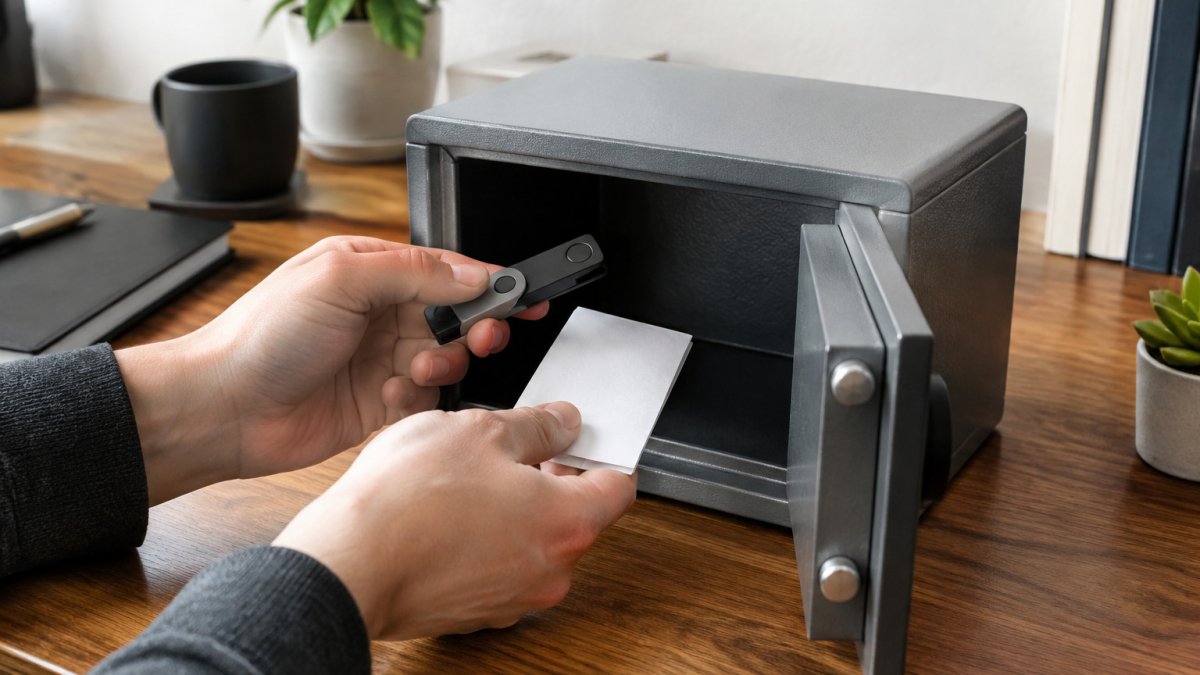
Fire resistance
Paper chars and becomes unreadable well before a house fire reaches peak temperature, while metal backup plates survive heat that destroys paper. When a listing says "fire-retardant," look for specific construction and a documented rating rather than the phrase alone.
Watch out: a fire-resistant safe that is opened while still hot can flash over when air reaches overheated contents, so follow the manufacturer's cooling instructions after any fire event.
Water and impact resistance
Water damage is the quiet failure mode: a basement flood, burst pipe, or spilled drink can destroy a paper phrase that survived a fire. Look for a gasket, sealed lid, or explicit water-resistant rating. Impact matters too, since a safe dropped during a move can crack seams or jam the lock. A hard case with shock-absorbing foam protects a hardware wallet from drops and crushing, but it is not a substitute for lockable storage.
Tamper resistance and tamper evidence
Tamper resistance slows forced entry; tamper evidence tells you entry was attempted. A solid steel body, welded or reinforced seams, and a recessed or shielded lock cylinder raise the effort required to pry a safe open.
Access control: key, keypad, or biometric
Each unlock method carries a distinct failure mode:
- Key locks are simple and battery-free, but a lost key means a locksmith or a drill, and a copied key defeats the safe silently.
- Keypads allow multiple codes and easy changes, but depend on battery power and can wear or fail; keep a mechanical override and a spare battery plan.
- Biometric fingerprint locks offer fast, keyless access, but enrollment limits, sensor wear, wet or damaged fingers, and battery depletion can lock you out. Check enrollment capacity, whether a backup code or key exists, and how the battery is replaced.
Choose a primary method you can operate reliably and a backup method you have actually tested. A safe you cannot open under stress is worse than no safe.
Size, weight, and portability trade-offs
Portability cuts both ways: a safe light enough to carry is also light enough for someone else to carry off, while a heavier safe resists removal but defeats the point of a portable unit. Weigh internal dimensions against what you actually store, a folded paper phrase, a metal backup plate, a hardware wallet, and possibly a passport or document.
Discreet storage
A plain, unbranded exterior draws less attention than a glossy box with a security logo. Discretion is not security, but it reduces the chance a visitor, cleaner, or contractor notices the safe. Pair a low-profile exterior with placement away from bedrooms and home offices, the first places a burglar searches.
What a safe cannot do
A portable safe does not protect against coercion, a compromised recovery phrase, a phishing site, or a malware-infected computer, and it does not encrypt anything. If someone obtains your phrase by other means, the safe is irrelevant. That is why it belongs inside a broader routine: offline phrase storage, a tested recovery process, and access rules limiting who knows the combination or has an enrolled fingerprint.
Comparing the Vicosmos and Casematix Options Available Here
Our current catalog includes several portable safes and cases suited to different needs.
| Product | Price (USD) | Best For | Key Notes |
|---|---|---|---|
 Vicosmos MASTER M1 PRO |
$159.95 | Top-tier biometric storage | Fire-retardant material; multiple unlock methods |
 Vicosmos MASTER M1 |
$99.99 | Biometric storage on a budget | Fingerprint enrollment up to 10; 5 color options |
| Vicosmos OFFICE V1 | $89.95 | Larger items and documents | Mortise lock; 1800N security cable tensile |
| Vicosmos OFFICE V1 PRO | $109.95 | Home, office, and travel use | Fingerprint-style controls; larger interior |
| Casematix Hard Case | $22.99 | Transporting a hardware wallet | Shock-resistant, water-tight case |
Vicosmos MASTER M1 PRO ($159.95) suits buyers who want the highest tier of biometric storage.

Vicosmos MASTER M1 ($99.99) offers fingerprint access with up to 10 enrolled prints and is lighter and more compact than the PRO. Its listing states the battery is easily replaceable, so plan periodic battery checks.

Casematix Hardware Wallet Hard Case ($22.99) is not a safe.
For most buyers storing recovery materials at home, we recommend starting with a biometric Vicosmos model.
Hardware Wallet Travel Security and Safe Placement at Home
Most wallet comparisons stop at the device. The harder questions are where the safe lives, who can open it, and what happens if it is lost, stolen, or destroyed. Threat modeling answers them.
Match the safeguard to the threat
Different risks call for different controls, and no single product covers all of them:
- Opportunistic theft (burglary, a roommate, a visitor): a lockable safe, discreet placement, and limited knowledge of its existence.
- Targeted theft or coercion: separation of the safe from the device, a decoy or low-value safe, and a plan for what you would disclose under pressure.
- Household access (family, contractors, cleaners): access rules, a safe that is not in a bedroom or home office, and tamper-evident seals inside.
Write down which two or three of these apply to you before you buy. The right safe for a renter in a shared apartment is not the right safe for someone who travels weekly.
Placement at home
Place the safe out of sight and away from the rooms burglars search first, typically the primary bedroom and home office. Avoid the top dresser drawer, closet shelf, desk, and nightstand.
Watch out: a portable safe that is visible during a video call, a delivery, or a repair visit has already lost much of its discretion, so check sightlines from doorways and windows.
Access control and who knows what
Decide in advance who can open the safe and how. A common pattern is one primary person with biometric or keypad access and one trusted backup with a sealed emergency code stored separately. Register only the fingerprints you need, review enrollments periodically, and change keypad codes after anyone with access moves out or changes roles.
Backup redundancy without a single point of failure
One safe in one place is a single point of failure. A practical structure is two copies of the recovery materials in two separate secure locations, each protected by a different access method, so loss, theft, or disaster at one location does not remove your only path back to the funds. Do not store both copies in the same bag, room, or building.
Travel procedures
When you travel with a hardware wallet, keep the device and recovery materials separate, and never place recovery materials in checked baggage. Tamper-evident bags make interference visible; a Faraday bag blocks wireless signals from Bluetooth- and GPS-enabled devices. Both supplement, not replace, a lockable container. At hotels, use the in-room safe only for low-value items and keep recovery materials with you or in a locked portable safe you control.
Test the plan, not just the products
A storage plan is only as good as its recovery path. Practice recovering access from your backup with a small amount before relying on it, confirm the safe opens with every registered method, and re-check batteries, seals, and codes every few months. The goal is a routine that survives a lost key, a dead battery, a move, and a fire, not a collection of products that look secure on a shelf.
Choosing Your Portable Safe and Setting Up Storage This Week
Work through these steps this week:
- Confirm your hardware wallet is genuine and set up correctly.
- Move the recovery phrase to a dedicated offline backup.
- Choose a portable safe that fits your device, recovery materials, and budget.
- Set access rules and register fingerprints or codes.
- Add tamper-evident bags or a Faraday bag if you travel.
- Test your recovery process with a small amount before relying on it.
Storage habits matter as much as the product you buy. Review your setup every few months, and confirm the safe, backups, and access codes still work.
Frequently Asked Questions
What is the safest way to store your crypto assets?
Keep the bulk of long-term holdings on a hardware wallet that is disconnected from the internet when not in use, and store the recovery phrase separately on paper or metal in a secure location. A portable safe adds protection against theft, fire and casual discovery for both pieces. The Vicosmos MASTER M1 PRO at $159.95 and the Vicosmos OFFICE V1 at $89.95 are examples of lockable units suited to this role. Pair any safe with a tamper-evident bag, such as the BitBox 5-pack at $14.99, to spot unauthorized access.
Should you store a hardware wallet in a portable safe?
Yes, when the safe is used as one layer among several. A hardware wallet stored in a locked unit is harder to steal and less likely to be found by someone who gains access to your home. Keep the safe out of obvious spots, and never store the recovery phrase in the same container as the device. Hardware wallets are designed to be stored offline, so a physical enclosure is a practical complement to their own PIN and passphrase protection.
Is a portable safe enough to protect crypto assets?
A portable safe alone is not enough. It protects against theft and casual access, but it does not protect against a lost recovery phrase, a compromised PIN or a phishing attack on your accounts. Combine the safe with a verified hardware wallet, a recovery phrase stored offline, and a separate faraday bag such as the Signal Killer at $17.95 if you want to block wireless signals. Review the setup periodically.
Can you travel with a hardware wallet and recovery phrase?
You can, but carry them separately. Keep the hardware wallet in a protective case such as the Casematix hard case at $22.99, and carry the recovery phrase in a different location, never with the device. Use a faraday bag if you want to block Bluetooth signals during transit. Avoid storing either item in checked luggage where it can be lost or damaged, and never enter your recovery phrase on a device you do not control.


