

Last Updated: November 4, 2026
Quick Summary
A faraday bag blocks Wi-Fi, Bluetooth, cellular, GPS, RFID and radio signals around your devices, removing the wireless attack surface on Bluetooth-enabled hardware wallets between signing sessions. It also stops phones from syncing or reporting location, but it cannot stop malware, phishing, or a compromised recovery phrase.
- Seal the hardware wallet in the bag whenever it is not actively signing a transaction.
- The Signal Killer Faraday Bag costs $17.95 and lists 60-80dB average attenuation.
- Judge a bag by its closure first: a roll-top with full-width velcro seals best.
- Run the five-test sequence when the bag arrives, after any trip, and every few months.
- A seed phrase is not a radio device, so a bag does nothing for it directly.
Table of Contents
- What a Faraday Bag Actually Blocks (and What It Doesn't)
- Threat Modeling Your Crypto Custody: Who Is Actually Trying to Reach Your Device
- How to Protect Hardware Wallets From EMP and Wireless Hacking
- Best Practices for Crypto Cold Storage Beyond the Bag
- Choosing a Faraday Bag: Materials, Closure, and Shielding Effectiveness
- Crypto Operational Security Tips for Travel and Public Places
- Test Your Shielding Before You Trust It
- Add a Signal Killer Faraday Bag to Your Setup
- Frequently Asked Questions
What a Faraday Bag Actually Blocks (and What It Doesn't)
A Faraday bag is a pouch lined with conductive material that creates a shielded enclosure around whatever you put inside it. For crypto holders, that means a faraday bag cuts the wireless link between your hardware wallet and every radio signal in the room.
The bag works on the principle Michael Faraday documented: a conductive shell redistributes an external electric field around its interior.
Signals Stopped by a Faraday Cage
A properly sealed Faraday cage blocks the frequencies your devices actually use:
- Cellular signal (4G LTE+)
- Wi-Fi at both 2.4 GHz and 5 GHz
- Bluetooth, the channel hardware wallets use to pair with a phone
The Signal Killer Faraday Bag we carry lists an average attenuation of 60-80dB.
The Limits Nobody Mentions
A Faraday bag is not a complete privacy solution.
Nor does it stop malware, a compromised recovery phrase, or a phishing page that talks you into typing your seed words.
Threat Modeling Your Crypto Custody: Who Is Actually Trying to Reach Your Device
A Faraday bag is a control, not a strategy. Before you buy one, decide which asset you are protecting and which adversary you actually face. Crypto custody is unusual because the asset is information, a seed phrase or private key, and information can be copied without your knowledge.
Map each asset to its real exposure
Hardware wallet (signing device). The device holds keys, but a modern hardware wallet keeps them inside the secure element.
Seed backup (paper or metal). A seed phrase is not a radio device, so a Faraday bag does nothing for it directly.
Laptop used for transaction prep. A laptop in a bag is offline in the radio sense, but if it was compromised beforehand, sealing it changes nothing.
Separate realistic attacks from privacy theater
The realistic crypto threats generally fall into four buckets: malware and phishing that trick you into revealing a seed, physical theft of a device or backup, supply-chain tampering before purchase, and opportunistic NFC scanning of cards or phones in crowds. A Faraday bag meaningfully helps with the fourth and partially with transport-related theft. It does not help with the first, and it does not help with a compromised recovery phrase.
A common pattern is to overestimate the wireless attacker and underestimate the social one. Remote key extraction over Bluetooth from a hardware wallet is a narrow, difficult attack requiring proximity and a specific vulnerability; a phishing page that asks you to type your seed words works every day. Spend effort in proportion to likelihood.
A short threat-model worksheet
Before buying, answer four questions in writing:
- Which devices in my setup have active radios (cellular, Wi-Fi, Bluetooth, GPS, NFC)?
- For each, is the realistic adversary remote, physical, or opportunistic?
- Which of those adversaries does signal isolation actually stop?
- What control covers the adversaries the bag does not stop?
If the answer to question 3 is "none" for a device, the bag is not the right tool for it. If the answer is "the opportunistic scanner" or "a wireless attacker while the device is idle," the bag earns its place.
How to Protect Hardware Wallets From EMP and Wireless Hacking
Protecting a hardware wallet from EMP and wireless hacking comes down to one habit: keep the device inside a sealed conductive enclosure whenever it is not actively signing a transaction.
Wireless hacking is the more common concern. A hardware wallet that stays offline has no radio to attack, but the moment it pairs over Bluetooth, it has an attack surface.
If your wallet never leaves a desk drawer, the bag adds little. If it travels, it earns its keep.
Best Practices for Crypto Cold Storage Beyond the Bag
Cold storage best practices start with the recovery phrase, not the device. Your seed words are the actual asset; the hardware wallet is a replaceable signing tool. Write the phrase on metal, store it somewhere a burglar will not think to look, and never photograph it or type it into anything connected to the internet.
From there, the routine looks like this:
- Keep the hardware wallet offline except during transactions.
- Verify every receiving address on the device screen, not the computer.
- Buy hardware only from an authorized distributor.
- Split large holdings across more than one wallet so a single failure is survivable.
- Store the device in a Faraday bag when it travels or sits unused for long stretches.
That last step is a small addition to a plan that already leans on offline signing and seed hygiene.
Choosing a Faraday Bag: Materials, Closure, and Shielding Effectiveness
Shielding effectiveness lives or dies on the closure. A pouch with a loose flap leaks signal at the seam no matter how good the fabric is, so judge a bag by how it seals before anything else.
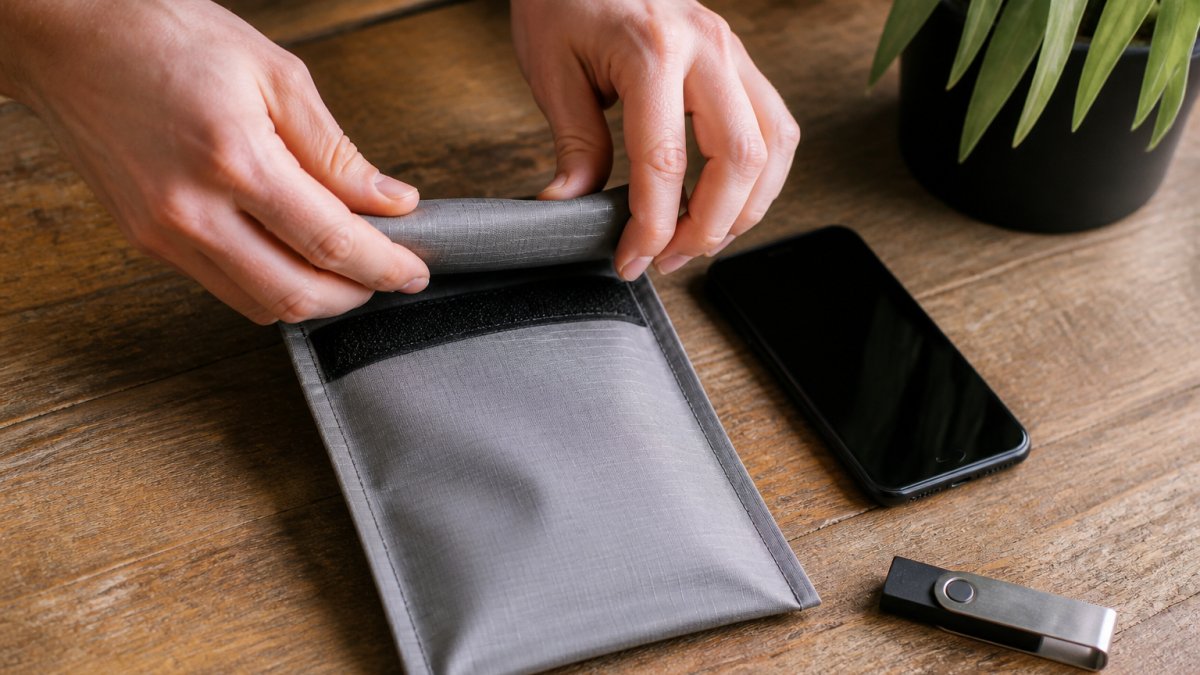
Look for three things:
- Conductive material. Copper mesh or nickel-copper fabric is standard. Ask for an attenuation figure rather than a vague claim.
- Closure design. A roll-top with full-width velcro strips seals better than a simple fold-over. The Signal Killer uses two velcro strips running the entire width of the bag.
- Size fit. The pouch must close fully around the device. A bag that barely fits leaves the seam strained and the shielding compromised.
Watch out: a bag with a worn or dusty velcro strip will not seal, and an unsealed bag blocks nothing. Check the closure every few months.
Judge a bag on these three features before you buy, because the closure decides whether the shielding works at all.
| Feature | What to look for | Why it matters |
|---|---|---|
| Conductive material | Copper mesh or nickel-copper fabric | Standard shielding fabrics; ask for an attenuation figure |
| Closure design | Roll-top with full-width velcro strips | Seals better than a simple fold-over flap |
| Size fit | Pouch closes fully around the device | A strained seam compromises the shielding |
| Attenuation figure | 60-80dB average on the Signal Killer | A number beats a vague shielding claim |
| Closure upkeep | Check the velcro every few months | Worn or dusty velcro will not seal |
Crypto Operational Security Tips for Travel and Public Places
Travel is where operational security habits matter most, because airports, hotels, and coffee shops all put your device near strangers with scanners and cameras.
Never announce on social media that you are traveling with crypto. Assume every public Wi-Fi network is hostile and do transaction prep on a trusted connection.
The same logic applies at home. A phone in a Faraday bag stops reporting its position to cell towers and stops responding to remote commands: the device goes quiet.
Test Your Shielding Before You Trust It
A spec sheet tells you what a new bag should do. A test tells you what your bag is doing today. Shielding degrades with creases, seam wear, and dusty closure strips, so the only reliable answer comes from a repeatable check you run yourself. The procedure below takes about five minutes.
What you need
- The bag, fully closed the way you will actually use it
- A phone with Wi-Fi, Bluetooth, GPS, and NFC enabled
- A second phone or a computer to place calls and send messages
Test 1: Cellular
Place the phone in the bag and seal it completely. From a second phone, call it and send a text. A properly sealed bag should prevent the call from ringing and the text from arriving until you remove the phone.
Watch out: if the call goes to voicemail immediately, that can mean the bag is blocking, or that the phone is off or in airplane mode.
Test 2: Wi-Fi
With the phone connected to a known network, seal it in the bag and try to load a page from the second device or watch whether the phone drops the network. A working bag will cause the phone to lose the access point within a few seconds. Note that some phones cache pages; use a fresh page you have not loaded before.
Test 3: Bluetooth
Pair the phone with a Bluetooth accessory, then seal the phone and walk the accessory out of normal range. If the pairing holds or the accessory stays connected, signal is escaping. A stronger check is to attempt a new pairing while the phone is sealed; a working bag should prevent discovery entirely.
Test 4: GPS
Open a maps app, let it fix your location, then seal the phone and watch the position indicator. A working bag will cause the app to lose its fix and show a stale or unavailable location. This is the test most people skip, and it is the one that matters if your concern is location tracking rather than data interception.
Test 5: NFC and RFID
Place an NFC tag or contactless card inside the bag and try to read it with the phone from outside. A working bag should prevent the read. Repeat with the phone inside and the tag outside, since the direction of the attempt matters for some bag designs.
Caveats that change the result
Signal strength is not uniform. A bag that blocks a weak signal at the edge of coverage may leak a strong one near a cell tower or powerful router, so test where you will actually use the bag. Bag wear matters more than most buyers expect: a creased seam, a stretched opening, or a velcro strip carrying lint can open a path for signal, and the failure is often partial rather than total.
Add a Signal Killer Faraday Bag to Your Setup
The gap between a hardware wallet that is merely offline and one that is genuinely isolated comes down to a pouch and a habit.
 Signal Killer Faraday BagView product
We carry the Signal Killer Faraday Bag at $17.95, made by Privacy Pros, the team behind the Billfodl.

Get started with The Crypto Merchant and give your devices a place to go quiet.
Frequently Asked Questions
What are the disadvantages of a faraday bag for crypto?
A faraday bag blocks radio-frequency signals, but it does nothing about sound, so a phone inside can still pick up nearby conversations. It also adds friction: you cannot receive alerts, sync a hardware wallet, or check balances while the device is sealed. Seams and closures wear over time, and a bag that is not fully rolled and fastened lets signals through. Treat it as one control in your setup, not a complete privacy or security solution.
Can a thief bypass a faraday bag?
A properly sealed bag with intact conductive mesh stops the wireless path, but physical theft is a different problem. Someone who takes the bag itself still has your device. That is why crypto operational security tips usually pair signal isolation with a strong PIN, a recovery phrase stored offline in a separate location, and never carrying more than you need. The bag removes remote access; it does not remove the need to protect the device physically.
How do I know my faraday bag actually blocks signals?
Run a simple test. Place your phone inside, seal the bag fully, then call it from another phone. If it rings, the seal is failing. You can repeat the check with Wi-Fi and Bluetooth enabled and watch whether the device stays disconnected. Do this every few months, and immediately if the velcro or seams look worn, because shielding effectiveness depends on the closure staying tight.
Does a faraday bag protect a hardware wallet from an electromagnetic pulse?
A conductive bag blocks radio signals when the device is inside and the bag is sealed. Pair it with best practices for crypto cold storage, such as keeping your recovery phrase offline and storing backups in separate locations, so a single event cannot wipe out access to your funds.
A Faraday bag is one layer, and it only works when the layers beneath it are solid. If your recovery phrase is stored carelessly or your wallet came from an unverified source, shielding will not save you. Start with a device you trust, then seal it.


