

Last Updated: October 26, 2026
Quick Summary
Multi-signature hardware wallets replace one private key with several, so no single compromised device, stolen seed, or coerced signer can drain a wallet alone. Each signer holds their own hardware wallet and approves transactions independently, converting a single catastrophic failure into a recoverable one. The trade-offs are higher fees, more hardware to buy, and slower signing.
- A 2-of-3 wallet creates three keys and requires any two to sign before funds move.
- Every signer needs its own device, so a 3-of-5 setup requires five hardware wallets.
- Back up the wallet descriptor alongside your seeds, or restored keys cannot rebuild the address.
- Lose two signers in a 2-of-3 and the funds are unrecoverable by any vendor or service.
- For a small balance held by one careful person, a single hardware wallet with a solid backup is a reasonable, simpler choice.
Table of Contents
- Why One Key Is One Point of Failure
- How Does a Multisig Wallet Work?
- Multisig Wallet vs Hardware Wallet: Different Jobs, Better Together
- The Benefits That Justify the Setup
- Bitcoin Multisig Setup: What the Process Looks Like
- Multisig Wallet Recovery When a Signer Is Lost
- The Trade-Offs: Cost, Complexity, and Compatibility
- Choosing Your Multisig Hardware
- Frequently Asked Questions
 Ledger Nano X PurpleView product
Why One Key Is One Point of Failure
A single private key is a single bet.
That is the uncomfortable truth about self-custody. Moving coins off an exchange removes counterparty risk but concentrates all security into one secret.
The benefits of using multi-signature hardware wallets start here. Multi-signature hardware wallets replace one secret with several, so no single compromised device, angry insider, or burgled safe can drain a wallet alone.
How Does a Multisig Wallet Work?
A multisig wallet is a wallet that requires more than one private key to authorize a transaction, with the rule written into the address itself rather than into software settings.
Bitcoin implements this natively through Pay-to-Script-Hash and Taproot script addresses. The spending condition lives on-chain, so every node enforces it, unlike a shared login, no provider sits in the middle and no support agent can override the rule.
M-of-N Thresholds: What 2-of-3 Actually Means
In an M-of-N setup, N keys exist and M of them must sign before funds move.
The practical effect is redundancy without surrender: lose one key and you still spend; lose two and the funds are frozen by design.
Threshold choice is the whole game. A 1-of-3 wallet is a single-key wallet with extra steps. A 3-of-3 wallet has no tolerance for signer loss.
What Happens at the Moment of Approval
Signing is a relay, not a handoff. One device builds the transaction, each required signer reviews and signs it independently, and the signatures are combined before broadcast.
Every approver sees the destination address and amount on their own screen. A compromised laptop can propose a fraudulent transaction but cannot force the other signers to approve it, that separation is where the security lives.
 Ledger Nano S PlusView product
Multisig Wallet vs Hardware Wallet: Different Jobs, Better Together
A hardware wallet protects a key; a multisig wallet protects a balance. Confusing the two is the most common conceptual error we see.
A hardware wallet keeps one private key offline and forces physical confirmation on the device. A multisig wallet defines how many keys must agree. Neither replaces the other.
Put them together and each signer holds a hardware wallet, so every approval happens on isolated hardware. For that hardware layer, the Cypherock X1 hardware wallet with four backup cards shows how a key can be split across components rather than stored whole.

The Benefits That Justify the Setup
The payoff is risk reduction across distinct failure modes. The real benefit of pairing multisig with hardware wallets is that the two layers cover each other's blind spots: a hardware wallet alone still fails if the single seed is lost or coerced, and multisig alone still fails if every signer keeps keys on an internet-connected machine. Together they close both gaps.
Theft and Unauthorized Transaction Defense
Remote attacks almost always target a single credential. Multisig removes the target. An attacker who compromises one device, one seed backup, or one signer's laptop still holds nothing spendable.
The same logic blunts physical threats. A stolen hardware wallet is useless without its PIN, and a stolen seed phrase is useless without the other signatures. Watch out: a 2-of-3 wallet where two keys sit in the same house is a 1-of-3 wallet in disguise.
Threat Models: What Multisig Actually Stops
Concrete scenarios make the benefit legible. Consider how a 2-of-3 multisig with three hardware wallets in separate locations handles each common attack:
- Device theft. A burglar takes one hardware wallet and its PIN. The thief holds one signature out of three. No funds move, and the owner rotates the compromised key at leisure.
- Malware and clipboard hijacking. A compromised laptop swaps a receiving address at the moment of a deposit or spend. Because every signer verifies the destination on their own device screen, the altered address is rejected by the other signers before broadcast.
- Phishing and seed extraction. A fake wallet site convinces one signer to type a seed phrase. That seed is now compromised, but it is one of three. The attacker cannot spend, and the owner sweeps funds to a fresh wallet.
What multisig does not stop is equally important. A compromised device that tricks every signer into approving a malicious transaction defeats the threshold, because the rule enforces count, not judgment. Signers must actually read what they sign. A supply-chain attack on the hardware itself, or a counterfeit device, can also defeat the model before the first key is generated, which is why buying from an authorized distributor matters.
Shared Control for Teams and Families
Shared ownership is where multisig becomes operationally useful rather than merely defensive. A business treasury can require a finance lead and an officer to co-sign every movement.
Approval workflows, not trust, govern the wallet. That is also why institutions and custody providers lean on multisig: it produces an auditable trail of who approved what, without handing control to a third party.
The Combined Benefit: Offline Keys Plus Independent Approval
The unique advantage of multisig hardware wallets is that offline key storage and independent approval reinforce each other. Each signer's key never touches the internet, so remote compromise of one machine yields nothing, and each approval happens on a separate screen, so a malicious proposal cannot silently collect signatures. An attacker must compromise multiple isolated devices and convince multiple humans, a far higher bar than compromising one.
Bitcoin Multisig Setup: What the Process Looks Like
Setup is a sequence of deliberate steps, and the discipline matters more than the software.
Cypherock X1 Hardware Wallet — Vault + 4 Cards →
- Choose a threshold, typically 2-of-3 for individuals.
- Initialize each hardware wallet separately and record each seed offline.
- Export each extended public key and combine them into one multisig wallet descriptor.
- Verify the receiving address on every device before funding it.
- Send a small test transaction and confirm the approval flow works.
- Store each seed backup in a separate, secure location.
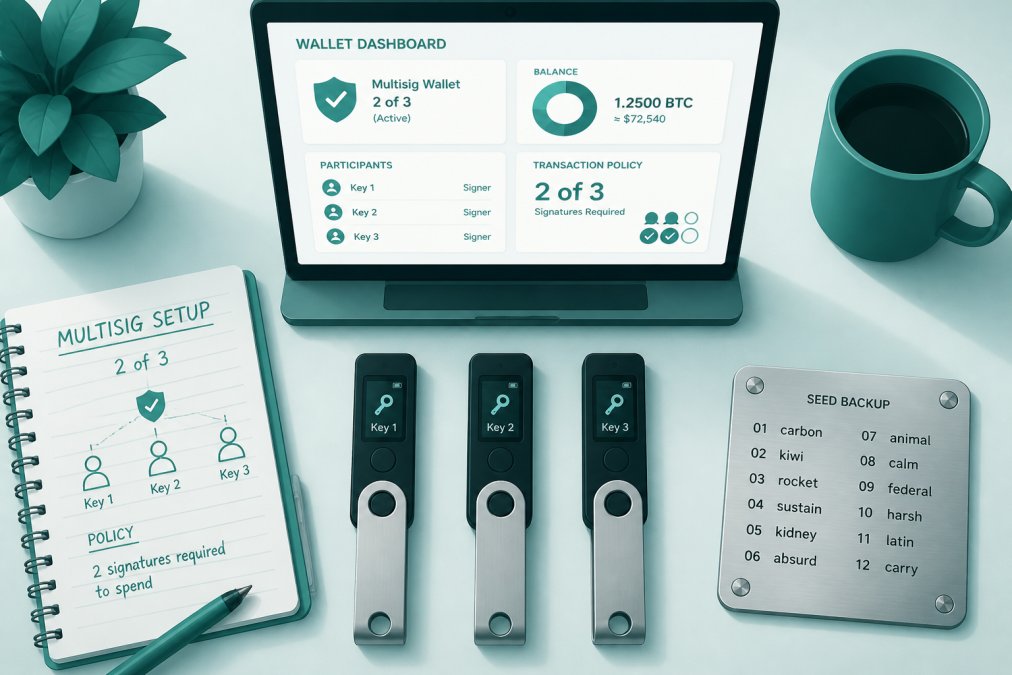
The step people skip is the descriptor backup. Your seed phrases recover keys; the wallet descriptor recovers the wallet. Without it, restored keys cannot reconstruct the address. Back it up alongside your seeds.
Multisig Wallet Recovery When a Signer Is Lost
Recovery is where multisig earns or loses its reputation.
Lose one signer in a 2-of-3 and you still control the funds. Sweep the balance to a freshly configured wallet with a new threshold rather than keep spending from a wallet at its safety limit, treat a lost signer as a prompt to rotate, not a permanent workaround.
Lose two signers and the funds are unrecoverable. No vendor, no support desk, and no recovery service can override an on-chain threshold.
Seed backups deserve the same planning. A Billfodl Multishard metal backup splits a 24-word seed into three 16-word shards so that any two reconstruct it, which mirrors the 2-of-3 logic of the wallet itself and keeps steel plates out of a single location.

The Trade-Offs: Cost, Complexity, and Compatibility
Multisig is not free. The trade-offs fall into four buckets: transaction fees, setup and hardware cost, operational friction, and compatibility limits.
Transaction Fees and On-Chain Costs
Each additional signature and public key adds data to a transaction, which can raise network fees, as Ledger's multisig explainer notes. On Bitcoin, a 2-of-3 Pay-to-Script-Hash spend is larger than a single-signature spend, and a 3-of-5 is larger still.
Hardware is the larger upfront cost. Every signer needs its own device, so a 3-of-5 setup requires five devices. Budget for the count, not the threshold.
Operational Friction and Signing Delays
Coordinating signers takes time: every signer must be reachable when funds move, and a 2-of-3 across time zones can turn a routine payment into a multi-day affair. Teams should agree on a signing cadence and a designated coordinator before funding the wallet.
There is also an operational tax in maintenance. Firmware updates, descriptor backups, and periodic recovery drills all consume attention. A wallet that has never been tested for recovery is a wallet whose recovery plan is unproven.
Compatibility and Implementation Details
Not every exchange or DeFi app recognizes multisig addresses, and some mobile wallets cannot parse them. Before committing, verify that your exchange supports withdrawals to your planned address type, that your wallet software imports and exports descriptors correctly, and that every signer's device supports the same signing standard.
Verifying transaction details across signers is the practical compatibility test. Each signer should see the same destination, amount, and fee on their own device. If one device displays a different address, stop and investigate before signing.
Choosing a Threshold: Security Versus Availability
Threshold choice is a trade-off between security and availability, and the right answer depends on who is involved.
- Individuals. 2-of-3 is the common default. It tolerates one lost or unavailable key while still requiring two independent approvals. A 1-of-3 is a single-key wallet with extra steps; a 3-of-3 has no tolerance for signer loss.
- Families. 2-of-3 or 3-of-5 works when keys are held by different adults in different locations. The goal is that no single person, and no single household, can move funds alone.
- Organizations and treasuries. 3-of-5 or higher is typical, because it tolerates one or two unavailable signers while still requiring a quorum. The cost is slower approvals and more coordination.
A useful rule: choose the smallest threshold that still requires cooperation among people who do not share a single point of failure, and the largest N you can realistically maintain.
When Multisig Is Not Worth It
For a small balance held by one careful person, a single hardware wallet with a solid backup is a reasonable, simpler choice. Multisig pays off when the amount at risk, or the number of people involved, justifies the coordination, for many retail holders, one hardware wallet plus a tested seed backup covers the realistic threat model.
| Setup | Keys Required | Best For | Main Drawback |
|---|---|---|---|
| Single hardware wallet | 1 | Small holdings, one person | One key, one point of failure |
| 2-of-3 multisig | 2 of 3 | Individuals with meaningful balances | Descriptor backup required |
| 3-of-5 multisig | 3 of 5 | Teams and treasuries | Slower approvals, higher fees |
Choosing Your Multisig Hardware
The hardware layer decides how pleasant or painful the system feels, and it is the one part you buy rather than configure.
Every signer needs its own device, so budget for the count. A Ledger Nano S Plus family pack of five covers a 3-of-5 team in one purchase, while a BitBox02 Multi Edition four-pack suits a smaller 2-of-3 group that wants Swiss-made simplicity and microSD seed backups.

Buy from an authorized distributor. Counterfeit and pre-tampered devices are the one attack multisig cannot stop, because the compromise happens before the wallet ever holds a key.
Frequently Asked Questions
Is a multi-signature wallet safer than a hardware wallet?
They solve different problems, which is why pairing them works best. A hardware wallet keeps a single private key offline so malware cannot reach it. Multi-signature hardware wallets add a second layer by requiring several independent keys, stored on separate devices, to approve any transaction. That removes the single point of failure: a stolen device or one compromised seed phrase is not enough to move funds. Most users get the strongest protection by running multisig across hardware wallets rather than choosing one approach over the other.
How many signatures do you need for a multi-signature wallet?
It depends on the M-of-N threshold you choose. A 2-of-3 setup needs two approvals from three key holders, so losing one device or signer still leaves you able to transact. A 3-of-5 setup requires three of five, which suits teams or larger portfolios where you want more redundancy. Higher thresholds add security but also friction: every approval is a separate step, and each additional signature adds data to the transaction, which can raise network fees.
Can you use different hardware wallets in a multisig setup?
Often yes, but compatibility is the deciding factor. Multisig coordination happens through wallet software that combines public keys into one shared address, and not every hardware wallet supports the same multisig standards. Before buying, confirm each device works with your chosen coordinator and supports the same script type, such as native SegWit multisig. A common approach is buying several units of one model, like a multi-pack, so every signer shares identical firmware and setup steps.
How do you recover a multisig wallet if a device is lost?
Recovery depends on your threshold. In a 2-of-3 setup, one lost device is not an emergency: the remaining two signers can still approve transactions, and you can register a replacement device as a new signer. If you drop below the threshold, you need the seed phrase backup for the missing signer, which is why each key holder should store their recovery words separately. Splitting a seed into shards, such as a 2-of-3 metal backup, keeps any single storage location from holding a complete recovery phrase.
Multisig is not complicated because the technology is hard. It is demanding because it forces you to plan for loss before loss happens.
That planning is what we do at The Crypto Merchant. We stock authentic hardware from Trezor and SecuX, ship from an authorized distributor, and help buyers match device count to their threshold. Get started with The Crypto Merchant and build a multisig setup that survives a lost key, a stolen device, and a compromised laptop.


