

Last Updated: November 9, 2026
Quick Summary
Tamper-evident bags give you visible proof that no one accessed your hardware wallet or seed backup between the factory and your safe. The core benefit is detection, not prevention: a bag will not stop a determined thief, but it makes sure you know the theft happened. That knowledge lets you move funds and regenerate keys before damage spreads.
- Photograph the sealed bag and record its identifier before you open the box.
- Store the tear-off receipt separately from the bag so a thief cannot take both.
- Use a two-person rule where one person retrieves the bag and another witnesses the seal inspection.
- Treat any broken seal as a full compromise of whatever was inside, not a partial one.
- No legitimate hardware wallet ships with a recovery phrase already created.
Table of Contents
- Why Tamper-Evident Bags Matter for Crypto Security
- How Tamper-Evident Seals and Closures Work
- Hardware Wallet Supply Chain Security: Closing the Physical Gap
- How to Verify Hardware Wallet Authenticity Before You Trust It
- Best Practices for Storing Seed Phrases with Tamper-Evident Bags
- Limits of Tamper Evidence: What Bags Can and Cannot Prevent
- Choosing the Right Tamper-Evident Bags for Your Setup
- Secure Your Backup with Tamper-Evident Bags Today
- Frequently Asked Questions
 Trezor Model TView product
Why Tamper-Evident Bags Matter for Crypto Security
A hardware wallet protects your private keys from remote attackers, but it cannot tell you whether someone opened the box before it reached your desk. That gap is where benefits of using tamper evident security bags for crypto become concrete: the bag gives you visible proof that no one accessed your device or backup between the factory and your safe.
A common question is simple: how do I know this device wasn't compromised before I opened it? A tamper-evident bag answers that question with physical evidence rather than trust.
The core benefit is detection, not prevention. A bag will not stop a determined thief. It will make sure you know the theft happened, which is often the difference between losing one backup and losing an entire portfolio.
How Tamper-Evident Seals and Closures Work
A tamper-evident bag is a sealed container built so that opening it leaves irreversible traces. The adhesive closure is designed so that opening it leaves visible evidence of tampering.
Three components do the work:
- The adhesive closure creates a bond that cannot be resealed without obvious damage
- Security seams are built into the bag construction
- Tear-resistant foil resists pinhole attempts and punctures
Tamper-evident bags of this type are often sold with a tear-off receipt, so you can log the serial number separately from the bag itself. That receipt is the accountability layer: if the bag number and the receipt number do not match, something went wrong.
 Trezor Model OneView product
Hardware Wallet Supply Chain Security: Closing the Physical Gap
Supply chain attacks target the physical path, not the software. A device can leave a factory sealed and arrive at your door resealed, with a pre-loaded seed phrase or modified firmware. This is why hardware wallet supply chain security depends on inspection you can verify yourself.
The practical defense is layered. Buy from an authorized distributor where possible. Inspect the packaging before you open anything. Then verify the device itself against the manufacturer's own checks.
Watch out: the most common mistake is opening the box first and checking the seal later. Once the packaging is open, you have destroyed the evidence you needed. Photograph the sealed bag and record its identifier before you touch the contents.
How to Verify Hardware Wallet Authenticity Before You Trust It
Verifying hardware wallet authenticity means confirming three things: the device is genuine, the firmware is official, and the recovery materials were generated by you, not shipped pre-filled.
Follow this sequence:
- Check the outer packaging and tamper-evident bag for cuts, resealing, or mismatched identifiers
- Confirm the device came from an authorized distributor with a verifiable order record
- Run the manufacturer's official authenticity check through its own app or website
- Update firmware only through the official vendor tool
- Generate a new recovery phrase yourself during setup
If a device arrives with a printed seed phrase, a scratch-off card, or a pre-written recovery sheet, stop. No legitimate hardware wallet ships with a recovery phrase already created. That is the single clearest sign of tampering.
CISA guidance on supply chain risks outlines how physical and digital supply chain threats overlap, and the same logic applies to a device sitting in a drawer before you unbox it.
Best Practices for Storing Seed Phrases with Tamper-Evident Bags
Best practices for storing seed phrases start with one rule: the phrase never sits in plain paper inside a drawer. Write it on a durable medium, seal it in a tamper-evident bag, and log the bag's identifier somewhere separate. That is the baseline every competitor states.
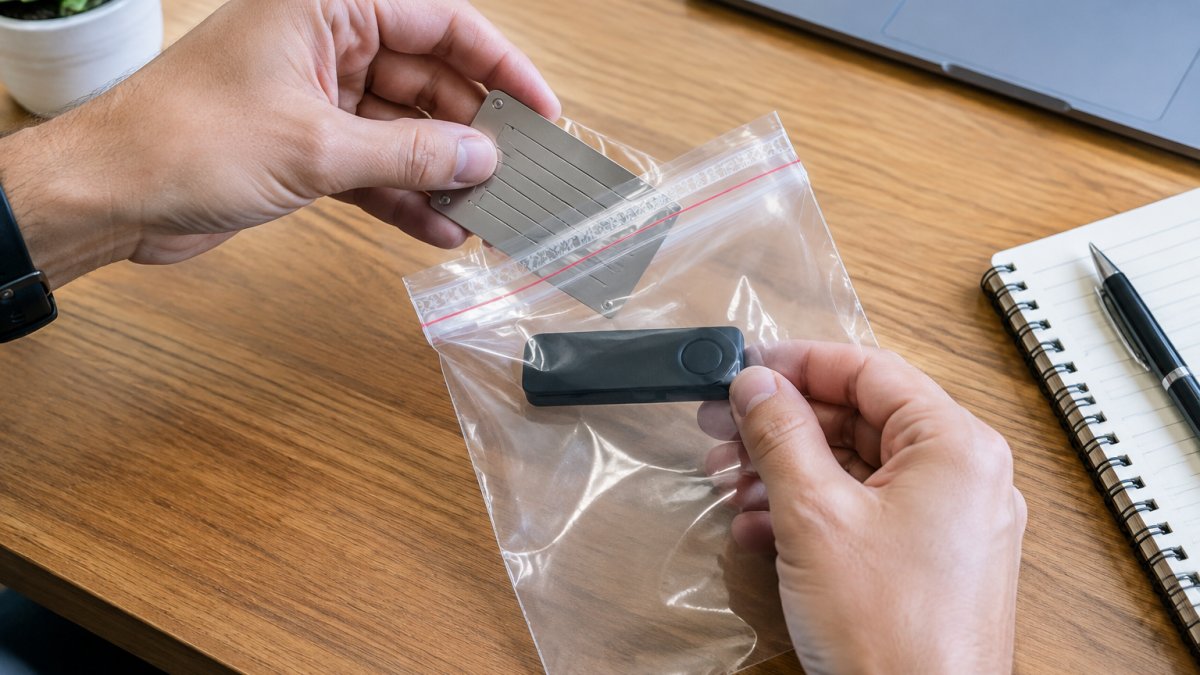
A workable routine looks like this:
- Place the seed plate and hardware wallet inside the bag on a flat surface
- Press out excess air to limit moisture exposure
- Peel the adhesive backing, fold the top over, and press the seal firmly
- Tear off the receipt and store it apart from the bag
- Record the date, bag identifier, and contents in a custody log
That routine is necessary but not sufficient. A tamper-evident bag only helps if the identifier is recorded somewhere an attacker cannot quietly edit. Photograph the sealed bag and the tear-off receipt together, then store the photo in a separate location from the bag itself.
Separate custody from access. The person who can open the safe should not automatically be the person who can open the bag, and neither should be the only person who knows the bag identifier. For a self-custody setup, that may mean one family member holds the bag location while another holds the receipt log.
Fit the bag into the recovery plan, not just the storage plan. If you use a multisignature arrangement, decide in advance which keys are backed up on physical media inside bags and which are held by other signers or devices.
Watch out: sealing a seed phrase you generated on a phone, a screenshot, or a cloud note defeats the purpose. The bag certifies physical custody of a backup, not the security of how that backup was created. Generate the phrase on the hardware wallet itself, write it by hand or stamp it into metal, and only then seal it.
BitBox tamper-evident bags are built with a strong seal, security seams, and tear-resistant foil, and the transparent material allows visual checks. They provide space for steel sheets and the hardware wallet itself.
Limits of Tamper Evidence: What Bags Can and Cannot Prevent
Tamper evidence is a detection tool, not a vault. A bag cannot stop a thief with time and tools, and it cannot protect against threats that never touch the physical object. Competitors tend to stop there. The more useful distinction for crypto holders is between what a seal can prove and what it cannot, and between physical access and the digital and human threats that bypass packaging entirely.
What bags cannot do:
- Prevent a skilled attacker from defeating a seal with enough time and tools
- Prove who opened the bag, only that it was opened
- Stop phishing, malware, or remote key theft
- Protect a seed phrase you photographed and left on your phone
- Recover assets if you lose the bag and the receipt together
- Address coercion, where someone forces you to open the bag yourself
What bags do well is make interference visible. If someone opens the bag, you know. That knowledge is what lets you act: move funds, regenerate keys, and check accounts before damage spreads. But the evidence is narrow. A broken seal tells you the contents were accessible; it does not tell you whether the attacker copied a seed phrase, swapped a device, or simply looked. Treat any broken seal as a full compromise of whatever was inside, not a partial one.
The threats beyond physical access deserve equal weight. Phishing sites that mimic wallet vendors, malware that swaps a receiving address at the moment of a transaction, and compromised devices that leak a seed phrase all operate without ever touching a bag. Insecure seed-phrase creation, such as generating a phrase on a general-purpose computer or photographing it, creates a copy that no seal can recall.
The honest trade-off is operational. Every seal you open costs you a new bag, and every bag you log costs a few seconds. For a large portfolio held in cold storage, that cost is trivial against the alternative. The bigger cost is discipline: a log that is not updated, a receipt stored next to the bag, or an inspection done without a witness all reduce the value of the seal to near zero.
NIST cybersecurity framework treats detection and response as core functions alongside prevention, which is exactly the role a tamper-evident bag plays in a physical custody setup. The framework's logic also explains the limit: detection without a response plan is just a record of the loss.
Choosing the Right Tamper-Evident Bags for Your Setup
Choosing comes down to four features: seal strength, seam construction, material durability, and whether the bag carries a unique identifier you can log. Size matters too, since you may want room for a steel plate and the wallet together.
| Feature | What to Look For | Why It Matters |
|---|---|---|
| Adhesive closure | Bonds permanently, shows void marks | Reveals any reopening attempt |
| Security seams | Reinforced, visible if cut | Detects edge slicing |
| Foil material | Tear-resistant, transparent | Blocks punctures, allows visual checks |
| Unique identifier | Serial number plus tear-off receipt | Enables custody logging |
| Interior space | Fits plate and device together | One seal covers both items |
A pack of five gives you several bags for a backup and spares. If you want a specific product ready to ship, you can shop tamper-evident bags in a five-pack sized for a hardware wallet and steel backup plate.

Best for: anyone holding a hardware wallet and a physical seed backup at home or in a safe. Skip if: you keep no physical backup at all and rely entirely on a multisig arrangement with distributed keys.
Secure Your Backup with Tamper-Evident Bags Today
The gap between a secure device and a secure setup is physical evidence. A hardware wallet guards your keys; a tamper-evident bag guards the question of whether anyone touched them.
If you are building that layer now, start with the bag, then the log, then the routine. The Crypto Merchant stocks tamper-evident bags alongside authentic hardware wallets, and as an authorized distributor of Trezor and SecuX devices, we can help you match a bag to the hardware you actually own.
Get started with The Crypto Merchant and seal your backup with evidence you can check.
Your backup is only as strong as the last person who handled it. Seal it, log it, and check it on a schedule. Browse our tamper-evident bags and hardware wallets to build a setup where any interference shows up before it costs you.
Frequently Asked Questions
What is the primary purpose of tamper-evident security bags for crypto?
Tamper-evident bags are designed to show visible evidence if someone has opened or accessed your hardware wallet or backup. They do not prevent access, but they make any unauthorized attempt obvious through a strong seal, security seams, and tear-resistant foil. This helps you detect hidden tampering before it leads to loss, giving you a chance to move funds and secure accounts. For crypto holders, this physical layer complements digital security by covering the offline gap.
How can tamper-evident bags protect a hardware wallet during shipping?
When you buy a hardware wallet, it passes through multiple hands before reaching you. A tamper-evident bag seals the device and its accessories in a transparent, tear-resistant package. If the bag arrives with a broken seal or punctured foil, you know the contents may have been compromised. Always inspect the bag before opening and verify the wallet's authenticity through the manufacturer's official app. This simple check adds a crucial layer of hardware wallet supply chain security.
Are tamper-evident bags effective against sophisticated supply chain attacks?
Tamper-evident bags raise the difficulty of undetected interference but are not foolproof against determined attackers with advanced tools. They are most effective when combined with other verification steps, such as buying from authorized dealers, checking holographic seals, and confirming the device's firmware. No single physical measure guarantees safety; instead, use tamper-evident bags as part of a layered defense that includes secure seed phrase storage and regular account monitoring.
Can tamper-evident bags be reused for long-term crypto storage?
Most tamper-evident bags are designed for single use because the adhesive closure and security features are compromised once opened. Reusing a bag defeats the purpose, as you cannot guarantee the seal's integrity. For long-term storage, use a fresh bag each time you access your backup, and record the unique serial number and tear-off receipt in a separate secure location. This practice maintains a clear chain of custody and ensures any access is documented.


